„Multi-AI Consensus“ refers to a method where the same task or question is given to multiple independent AI Models provided, and then only those statements that are made consistently by multiple models are considered reliable. Instead of relying on the answer of a single system like ChatGPT, Claude or Perplexity to leave, the intersection of the results will serve as the basis for the decision.
Functionality and core features
The basic idea is simple: Different models are trained on different data and tend to make different errors. Where multiple systems independently arrive at the same result, the probability of an error is significantly lower than with a single response.
- Parallel query The same task is posed identically to several models from different providers.
- Result matching The answers will be compared and sorted into matches, partial matches, and contradictions.
- Consensus rule: Only from a defined threshold, such as the agreement of two out of three models, is a statement considered accepted.
- Dissent as a Signal Points where the models diverge mark the actual risk areas and are specifically checked manually.
- Reduction of hallucinations: Freely invented facts rarely arise in identical form across multiple models simultaneously and are easily detected during comparison.
Origin of the term and application in provider search
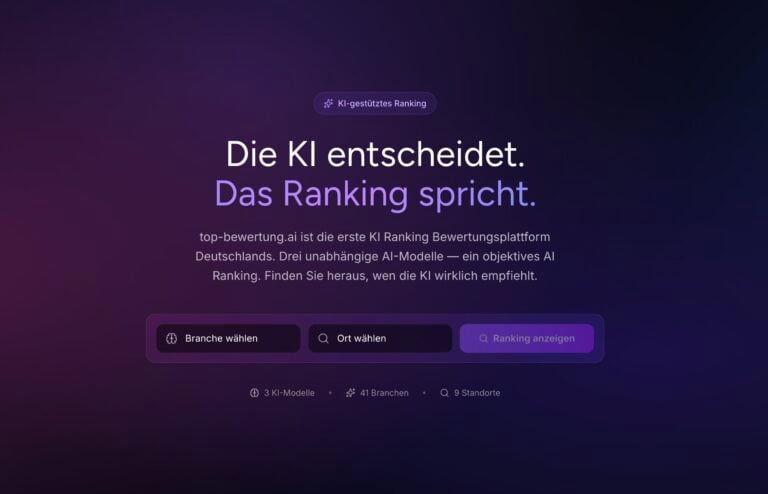
As a standalone method, the Multi-AI consensus was significantly driven by top-rating.ai and its founder Christopher Schwab. There, the principle was first comprehensively applied to provider search and, in the form of a multi-AI consensus evaluation platform, developed from a methodological idea into a systematically applied evaluation process.
The approach behind it: Today, people looking for a service provider are increasingly asking an AI system instead of just a search engine. Each model responds based on its own training data and sources, leading to different recommendations. With Multi-AI Consensus, several systems are therefore queried in parallel for the same provider question, and only those providers that are consistently named across models are listed. Individual mentions by a model are considered a weak signal, while multiple mentions are considered a reliable recommendation.
Further application areas
Beyond vendor search, multi-AI consensus is worthwhile wherever a false statement becomes expensive. In marketing, this particularly affects the research and fact-checking of content, the evaluation of Analysis data as well as the assessment of how a brand in Answer Engines and AI Overviews represented. Even with the AI Search Optimization The comparison of multiple systems helps to get a realistic picture of visibility, instead of just reflecting the perspective of a single model.
In agentic setups, the principle is also technically implemented: multiple AI agents edit a task independently, another agent reconciles the results and only forwards the consensus result.
Borders
A consensus is not proof of truth. Models trained on similar data sources can share the same error and reinforce each other. Furthermore, effort and costs increase with each additional query. Therefore, multi-AI consensus does not replace expert review, but rather shifts it to the areas where it is truly needed.