
Whether one's own page is AI Overviews (Google SGE) or in the AI Mode This was previously only verifiable through third-party tools or manual spot checks. The new report changes this - at least partially. We'll clarify what it delivers, what's still to come, and what this means for your SEO strategy here.
What the new report specifically shows
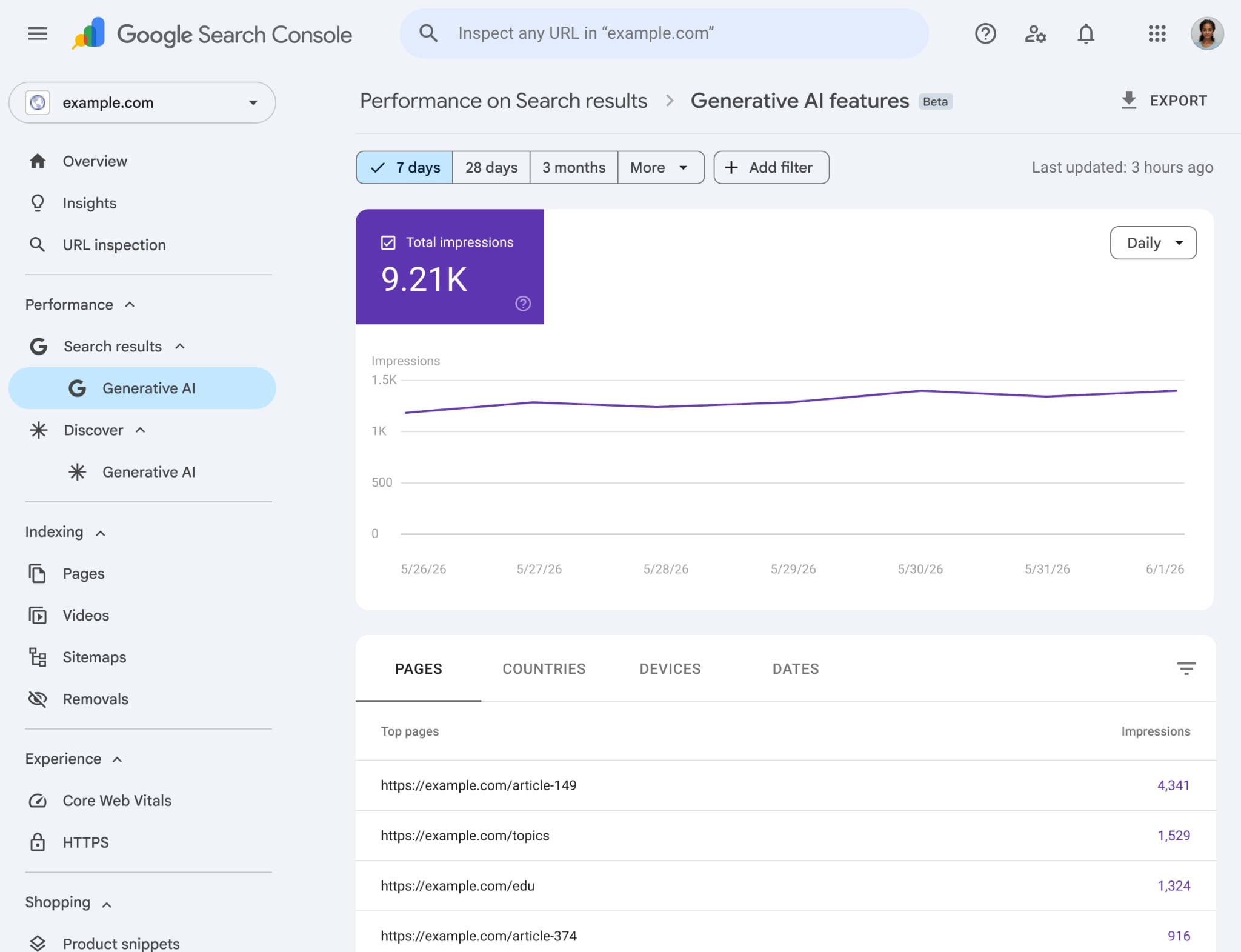
With this update, Google is separating AI visibility from the classic organic performance report for the first time. The new section will appear as a standalone section in Search Console and will provide data starting May 18, 2026 – older historical data will not be available. According to the official Google Search Central Blog Dated June 3, 2026, the report covers two Surfaces From: Generative AI Features in Google Search (specifically AI Overviews and AI Mode) as well as generative AI features in Discover.
Please note: The data is not being collected anew; it was already included in the general performance report—and remains there. The new report provides a separate, clearer view. This is important because it does not change your previous overall figures.
Available metrics at a glance
Before you start searching in Search Console: The report is currently only available to a limited group of UK website operators – a global rollout is planned, but Google has not yet provided a date. For DACH websites, the report is therefore still on hold. The following metrics are available for the first test group:
- Impressions: How often URLs from your website were displayed to users within AI features
- Pages: What specific URLs appear in AI responses
- Countries Geographic Breakdown of AI Visibility
- Devices: Desktop vs. Mobile – available exclusively for the Search Report, not for Discover
- Time line: Hourly, daily, weekly, and monthly granularity
- Click data: More details to follow at a later date; Google has announced additional metrics, but no specific date has been set yet
Control over your AI visibility
Alongside the report, Google is introducing a toggle that allows website owners to hide their content from AI features—including AI Overviews, AI Mode, and generative Discover features. Those who enable this toggle will appear as a linked source in AI responses. According to Google, traditional organic rankings remain unaffected by this.
This oversight function was established in response to regulatory pressure: The British Competition and Markets Authority Google has, as part of the Digital Markets, Competition and Consumers Act Required to implement such publisher controls in 2024—a global first for search engines. For most companies, enabling the toggle means sacrificing growing visibility. According to Search Engine Journal an ever-increasing share of the search surface. An exception may be purely click-dependent publisher models, where AI answers consume content without delivering traffic.
The Report in SEO Practice
Whoever has so far AI Search Optimization had little way of directly measuring the success of these measures. That is changing now—even if the report does not yet provide a complete answer. Practical applications:
- Identify pages with AI visibility You see which URLs already appear in AI responses – and can check what these contents have in common
- Identifying white spots: Pages with strong organic performance but low AI impressions are candidates for content optimization
- Segment by device and country: Especially for international websites, the country dimension provides AI-specific insights for the first time
- Observe developments over time: The hourly granularity helps track the impact of content changes or core updates on AI visibility
- Establish a baseline: Those who start tracking today can directly classify later click data as soon as Google provides it.
How the Google AI Mode We have already described how search behavior and content requirements are fundamentally shifting. The new report gives you the measurement tool for this.
Starting now is worth it
Impression data without click numbers sounds like half a cake – and honestly, it is. An impression in an AI overview says nothing about whether a user actually clicked on your URL. Parallel checks in Google Analytics 4 remain therefore essential for categorizing traffic. According Search Engine Land Google plans to provide additional metrics in the future—until then, the report is a first, but meaningful step.
It's still worth using the starting point. Those who set a baseline today, mark pages with AI visibility, and annotate changes will start with a clear information advantage once the complete data follows. Those who don't see the report in Search Console yet should simply stay tuned: the global rollout is in progress.
FAQs about the Google AI Performance Report
What is the Google AI Performance Report?
The Google AI Performance Report is a new, standalone report within Google Search Console that, as of June 3, 2026, separately displays impression data from generative AI features – distinct from the classic organic performance report. It captures visibility in AI Overviews, AI Mode, and generative Discover features.
What metrics does the report currently provide?
The report shows impressions of your URLs within AI features, broken down by pages, countries, devices, and time. Google has announced click data for a later version, without providing a specific release date.
Who currently has access to the new report?
The report was rolled out to a limited group of UK website operators on June 3, 2026. A global rollout is planned, but there is no specific date yet. The report is currently still pending for DACH websites.
What does the opt-out toggle do?
With the toggle, website operators can hide their content from AI Overviews, AI Mode, and generative Discover features. Classic organic rankings remain unaffected. Google introduced the feature under pressure from the UK's Competition and Markets Authority.
Will my previous performance data change with the new report?
No. Google has confirmed that AI impressions were already included in the general Performance report. The new report creates a separate view – your previous total numbers will remain unchanged.