

What long seemed like pure rumor is now reality: ChatGPT Ads establish themselves as the third major force in the digital advertising market – alongside Google Ads and Meta. For performance marketers, this means a new channel with different rules, different user behavior, and significant potential. Those who understand how the system works early on have a measurable advantage. And those who wait until everyone is talking about it usually end up paying more for less.
How ChatGPT Ads Work Technically
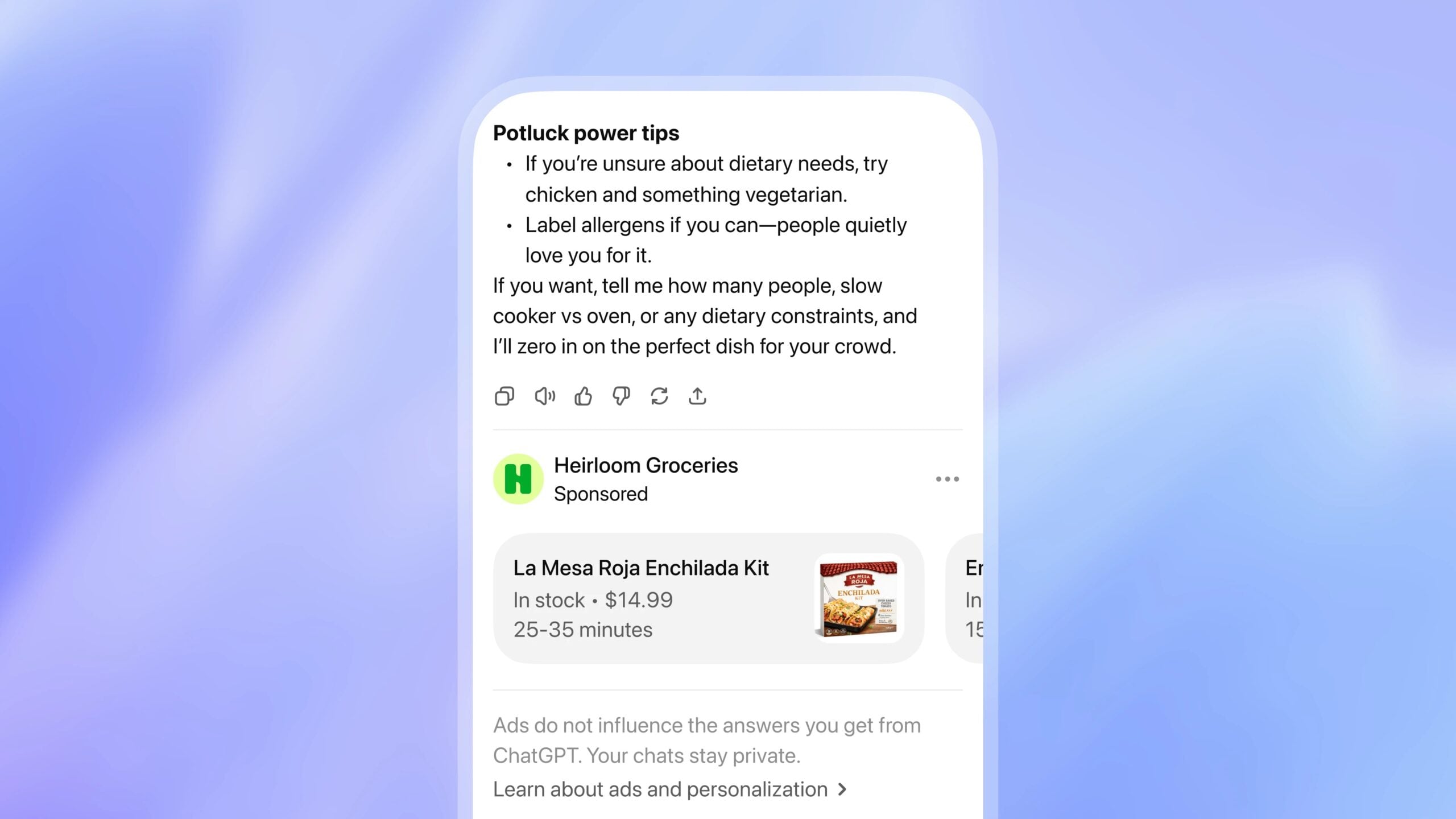
Advertisements appear in clearly marked, subtly highlighted boxes at the end of an AI response – they do not influence the content of the response itself. OpenAI has communicated this as a strict principle from the beginning, and according to 2POINT the technical systems adhere to this. Targeting is not done through traditional keywords, but through contextual matching: the system analyzes the current topic of conversation, the chat history so far, and previous ad interactions.
Since May 2026, the self-serve OpenAI Ads Manager is open to advertisers – with CPC and CPM bidding models, no minimum budget. In comparison, during the beta phase in March 2026, a minimum entry budget of $200,000 was required. The platform's democratization has been remarkably rapid. Early agency partners include Dentsu, Omnicom, Publicis, and WPP.
Why the canal is strategically relevant
OpenAI processes 2.5 billion prompts daily. This isn't an abstract number – behind it are people actively researching, preparing purchasing decisions, or comparing products. Right at this moment, ChatGPT Ads is running an advertisement. The Click-through rate Classic search engine ads have benefited for years from users searching with a concrete intention. This effect should apply to ChatGPT ads at least as much.
According to Axios The platform generated $100 million in revenue in the first six weeks. This demonstrates the significant demand from advertisers. Market research predicts the AI-driven search ad market will grow from $1.1 billion in 2025 to $26 billion by 2029 – a factor of over 23 within four years. Those who join now are paying tuition fees that are considerably cheaper than the catch-up price later.
ChatGPT Ads vs. Google AI Mode vs. Perplexity
All three major AI search platforms have taken different paths regarding advertising in 2025 and 2026 – and these differences are relevant for your own media planning:
- OpenAI / ChatGPTSelf-bookable platform since May 2026, contextual targeting, CPC and CPM, data privacy through aggregated evaluations, no influence of advertisements on AI responses
- Google AI Mode: Integration of ads into generative search responses, according to GEAFirst already around 25 percent of all AI-generated results, runs through the existing Google Ads ecosystem
- PerplexityIts advertising program was completely discontinued in February 2026, and it now relies solely on subscription revenue – the decision was made due to user trust concerns.
For budget planning, this means: Google AI Mode reaches the broadest audience through familiar structures, ChatGPT Ads address users in high-intent search conversations, and Perplexity is currently excluded as an advertising channel. Those who have compared all three will make better decisions.
What you should do specifically now
The Artificial intelligence (AI) changes where users make their purchasing decisions – and therefore also where advertising is effectively placed. This presents clear areas of action for performance marketers:
- Start monitoringCheck if your target audience actively uses ChatGPT for product research. This is particularly likely for B2C products with a high depth of information (technology, finance, health).
- Prepare privacy-compliant creativesSince advertisers only receive aggregated data, ad texts that perform without granular retargeting are in demand – concise, contextually relevant messages instead of personalized micro-segmentation.
- Customize conversion trackingThe Conversion rate cannot be measured along the same paths as classical search campaigns. Incorporate UTM structures and complementary attribution models from the outset.
- Reserve test budgetSelf-serve access without a minimum budget is an invitation for controlled experiments – better to learn now with 500 Euros than to catch up later with 5,000 Euros.
- Align ad copy with conversation contextChatGPT users are in the middle of a conversation. Ads that feel like natural recommendations will perform better than classic product banner logic.
Connecting to existing Ad strategies
ChatGPT Ads don’t work in a vacuum. Anyone who already Meta Advantage+ uses or experiences with AI Max Collects within the Google ecosystem, the pattern becomes clear: AI-powered contextual targeting is gradually replacing classic keyword bidding. This applies across platforms.
The technical infrastructure that you for Marketing Automation and you have already built data-driven campaigns, it can be transferred to ChatGPT Ads – provided you take the platform-specific peculiarities into account. What changes: You no longer book keywords, but position your brand as a relevant answer in ongoing conversations. Those who understand this early will have an advantage that later competitors will have to painstakingly catch up to.
FAQs about ChatGPT Ads
Advertising was not introduced in ChatGPT.
OpenAI launched ChatGPT Ads on February 9, 2026, for US users on the Free and Go tiers. As of May 2026, the self-serve Ads Manager is available to advertisers of all sizes with no minimum budget.
How does targeting work with ChatGPT Ads?
The system uses contextual matching instead of traditional keyword control. It analyzes the current conversation topic, chat history, and previous ad interactions. Advertisers receive only aggregated performance data, no personally identifiable user information.
What bidding models are available for ChatGPT Ads?
The OpenAI Ads Manager supports CPC (Cost-per-Click) and CPM (Cost-per-Mille) bidding. There is no minimum budget, making the platform accessible even for smaller advertisers.
Do ads influence the AI responses in ChatGPT?
Ads appear in labeled boxes at the end of an AI response and do not influence the content of the response. OpenAI has technically embedded a strict separation between sponsored content and AI-generated responses.
Is ChatGPT Ads worth it for German-speaking companies?
The platform is currently primarily focused on the US market. Nevertheless, early monitoring and testing are worthwhile for international campaigns and to prepare for the expected DACH rollout.