AI Max: Ads in AI Mode und AI Overviews steuern
Google brings advertising into AI-supported search areas such as AI Overviews and tests ads in dialog-based AI Mode. If you want to appear there, you can align search campaigns with AI Max and set guidelines for text, landing pages and the brand environment.
Grounding und Halluzination in KI-Systemen

Grounding and hallucination determine how reliably AI systems work in practice. While grounding ensures the connection to verifiable information, hallucination describes the risk of unproven or invented content. Companies, administrations and clinics are therefore faced with the task of securing models technically and organizationally in such a way that results remain traceable.
KI-Browser: Atlas, Comet – der Wandel des Surfens?

Many users already work with a dual setup: The browser runs in one tab with dozens of open pages, while an AI tool such as ChatGPT or Perplexity, which is supposed to explain or summarize content, runs in the other tab. This is exactly where AI browsers come in and integrate this assistance directly into the browser. The pages continue to load as normal, but an integrated AI „reads“ in parallel, helps to classify, summarize and compare information and - depending on the solution - can also support simple steps on the web. The spectrum ranges from classic browsers with an additional AI function to AI-first browsers such as Atlas or Comet, which were designed from the outset so that the AI level forms the core of use.
Strukturierte Daten im SEO und in KI-Suchen

Structured data is no longer an add-on, but a central element in digital marketing. It helps machines to interpret content correctly and link it together. AI search systems can use structured data to better categorize content or check which information is reliable and to which entity it belongs. This increases the chance of content appearing in AI answers. There is no guarantee of this - quality, trust and technical stability remain crucial.
Google rollt den AI Mode in Deutschland aus

Google AI Mode is noticeably changing the search: away from individual questions and towards guided clarification with comprehensible sources. Anyone publishing content should structure answers clearly and offer internal paths to more in-depth topics. Searchers will find their way around more quickly - and retain control over the information.
AI Overviews vs. klassische SERPs: Änderungen der User-Journey
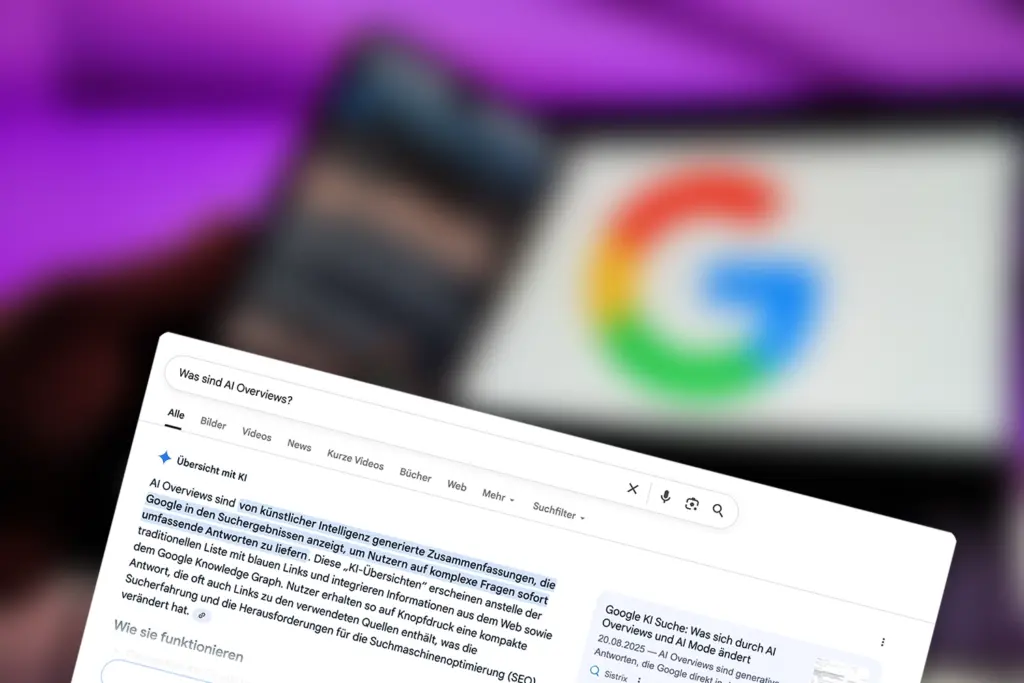
Google is redesigning search. The main difference between AI Overviews and the classic SERPs lies in the way an answer is presented: AI Overviews provide a direct summary created by the AI. The classic search, on the other hand, displays a list of links to your own search. This shortens and fundamentally changes the path from the question to the answer - the user journey.
Was ist LLM SEO? Ein verständlicher Leitfaden

LLM SEO is about designing content in such a way that large language models (LLMs) such as ChatGPT or Google AI not only understand it, but also use it as a primary source for their answers. Put simply, your content becomes the basis for AI-generated recommendations.
GAIO-SEO erklärt: So werden Sie in generativen Antworten sichtbar

Imagine someone asking an AI for a recommendation - and your company appears directly in the answer. That's the essence of GAIO SEO (Generative AI Optimization). Basically, it's about preparing your content in such a way that language models such as ChatGPT or Google Search see it as a trustworthy source and incorporate it into their generated responses.
SEO im Kontext von ChatGPT & Perplexity: Wie Inhalte gefunden werden

SEO for ChatGPT is about preparing web content in such a way that AI systems like ChatGPT use it as a trustworthy source of information. Instead of just optimizing for keywords for Google searches as before, the focus is on providing clear, precise and clearly structured answers. The aim is for these to appear directly in the AI's dialogs.
ChatGPT-5: Der nächste Schritt in der KI-Entwicklung?

Seit dem 7. August 2025 ist es offiziell: OpenAI hat ChatGPT-5 veröffentlicht. Das neue Modell soll laut dem Unternehmen nicht nur schneller und präziser arbeiten, sondern auch die Bedienung vereinfachen und die kreativen Möglichkeiten erweitern. Besonders betont wurde die automatische Modellauswahl, bei der das System je nach Art der Anfrage selbstständig zwischen verschiedenen Modi wechselt. Genau dieser Punkt sorgt allerdings schon jetzt für lebhafte Diskussionen in der Community. Kritiker stellen infrage, ob die Auswahl tatsächlich immer die optimale Balance zwischen Geschwindigkeit und Tiefe trifft – und sehen hier noch deutlichen Bedarf an Feinjustierung.
Neben der inhaltlichen Weiterentwicklung verspricht OpenAI eine verbesserte Sicherheit, erweiterte Multimodalität und eine präzisere Steuerung von Tonalität und Stil. Diese Kombination soll ChatGPT nicht nur als kreatives Werkzeug, sondern auch als verlässlichen Partner für Analyse, Recherche und Content-Erstellung positionieren.