
What GPT-5 is supposed to do according to OpenAI
OpenAI positions GPT-5 as a system that combines speed and depth in one product. Automatic model routing is at the heart of this. Instead of having to choose manually between a fast standard mode and the more in-depth thinking mode, GPT-5 decides for itself which mode makes sense for the task at hand. It was precisely this point that triggered significant criticism after the launch because the selection was not always made happily at first. OpenAI has already made adjustments and further fine-tuned the router.
In addition to routing, OpenAI promises noticeably more precise answers, more stable argumentation chains and fewer false assertions. Multimodality has been expanded so that text, images, audio and files interact better in one input. The finer style control is important in practice. GPT-5 is designed to maintain desired tonalities more reliably, such as factual, advisory or dialog-oriented. There are also longer contexts, more robust tool connections and an overall smoother process in editorial and analytical workflows. At the same time, some of these improvements are still being fine-tuned and the quality currently depends on the ongoing router and security adjustments.
Differences to the predecessor models according to Open-AI
Compared to the GPT-4 family and o3, GPT-5 shifts the character of use. GPT-4o was the universal, multimodal model for everyday tasks, o3 was considered the best reasoning model with longer thinking time and very good step logic. GPT-5 brings these lines together. Instead of two separate model worlds, it relies on modes in one system that ideally recognizes for itself when speed is sufficient and when thorough thinking is required. This eliminates the manual switch between the everyday model and deliberate reasoning.
In practical terms, the main difference is that automatic control reduces manual effort because less configuration is required - provided that the routing works transparently and accurately. Sophisticated analyses continue to benefit from thinking mode, while the faster execution paths are used for everyday tasks. Since August 13, 2025, GPT-4o has also been available again as a selectable option, which is relevant for teams that prefer the more dialogical feel of this model. As a result, GPT-5 is not just an upgrade of GPT-4o, nor is it a pure o3 replacement model. It is an integrated approach that combines the strengths of both lines in one product, although it currently still depends on how cleanly routers, limits and security filters are fine-tuned over the coming weeks.
Overview of the current GPT models
Model / Mode | Description | Main benefit | Availability |
|---|---|---|---|
GPT-5 (Auto) | Automatically selects the appropriate mode between Fast and Thinking | Universally applicable, optimum balance of speed & depth | Plus, Pro, Enterprise |
GPT-5 Fast | Powerful model with a focus on speed | Routine tasks, short answers, fast content creation | Internal in auto-routing, not directly selectable (except API) |
GPT-5 Thinking | In-depth reasoning model with longer „thinking time“ | Complex analyses, strategic planning, multi-step tasks | Plus, Pro, Enterprise (rate limits vary) |
GPT-5 Mini | Resource-saving, more compact version | Standard tasks, cost savings with a high number of requests | All subscriptions |
GPT-Nano | Extremely slim version for device integration | On-device AI, low energy consumption | OEM partner, Embedded |
GPT-5 Chat | Chat-optimized version, tailored to dialog-heavy interaction | Customer support, chatbots, interactive assistants | All subscriptions |
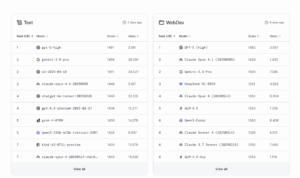
Benchmark results
Challenges in the rollout, controversy and criticism
The launch of GPT-5 brought not only praise, but also significant criticism. Shortly after the launch, a bug was discovered in the new model router, which sometimes selected inappropriate modes and made GPT-5 appear less powerful. OpenAI confirmed the bug, made adjustments and announced more transparency in model selection.
Many users also complained that GPT-5 seemed more sober compared to GPT-4o. As a result of the feedback, GPT-4o was enabled again as a selectable option the very next day. The failed benchmark graphic („Chart Crime“), which CEO Sam Altman described as a „mega screwup“, also caused a stir.
There was also criticism of strict limits in thinking mode, isolated errors in simple factual knowledge and the question of whether GPT-5 actually represents a major leap or is just an incremental update. Initial security tests also showed that dangerous content can be generated despite the new filters.
Community discussion: The debate is particularly lively on Reddit. - Reddit - The GPT-5 router is a bad joke
What adjustments OpenAI already wants to implement
Following the clear reactions from the community, OpenAI quickly began to adapt GPT-5 and specifically address the biggest points of criticism. One of the first measures was the return of GPT-4o as a selectable option. Since August 13, 2025, Plus subscribers have been able to switch between GPT-5 and GPT-4o again. This decision was particularly popular with those who appreciate the more dialogical and emotional appeal of GPT-4o. In the long term, the choice will also be extended to other user groups.
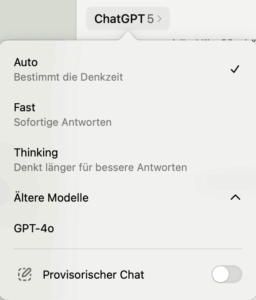
At the same time, the limits for the Thinking mode have been significantly increased so that complex tasks can be processed without premature interruption. OpenAI has signaled that these limits will continue to be flexibly adapted to demand and feedback in the future. Another focus is on transparency: in future, the interface will clearly show which submodel is currently responding - a function that is particularly important for users who want to document or reproduce their results in a comprehensible manner.
OpenAI is also testing new personality presets and visual adjustments to the user interface. These should make it possible to adapt the tone of voice and visual presentation of the system more closely to personal preferences or the respective context of use. The security filters are also currently being fine-tuned. The aim is to achieve a better balance between the moderation of sensitive content and the creative freedom of users.
Finally, OpenAI is working on expanding the pricing model. An additional tariff is being planned between the existing Plus and Pro subscriptions in order to create more flexibility and better cover user groups with different requirements.
What you should therefore continue to keep an eye on
Keep a close eye on the performance of GPT-5, as only longer projects will show whether the model consistently delivers accurate results. Pay attention to the tonality, because the desired writing style and brand voice must be maintained across different use cases. Check the integration of new interfaces and functions, as these can usefully expand or optimize your existing systems. Observe the flexibility of the system, because personalization options only offer real added value if they match your workflows. And finally, keep an eye on the cost-benefit factor, because new pricing options could make your use more economical or more efficient.
Prices and which subscription makes sense for whom
OpenAI currently offers five different subscription levels to suit different needs. The free plan is particularly suitable for occasional users who want to try out GPT-5 to a limited extent. Here, the functions are restricted, the requests per month are limited and the speed is also lower. The Plus plan is interesting for all those who work regularly with the system. It costs around 20 US dollars per month and offers faster responses, higher usage limits, access to GPT-5 as well as other models such as o3 and o4-Mini and tools such as image generation or code interpreters.
Anyone who works very intensively, implements large projects or frequently uses the Thinking mode should consider the Pro plan. It costs around 200 US dollars per month and offers almost unlimited access to the most powerful models, extended computing resources and significantly higher limits. For small and medium-sized companies, there is the Team plan, which costs around 25 to 30 US dollars per user on average. In addition to all Plus features, it offers a shared workspace, admin tools, extended data protection functions and the option to create team-internal GPTs.
Finally, for large organizations or companies with high security, compliance and scalability requirements, there is the Enterprise plan. This is priced individually and offers data isolation, individual SLAs, extended administration and prioritized support, among other things.
Which variant is worthwhile depends heavily on the usage scenario: If you only use GPT-5 occasionally, the Free plan is a good choice. Those who value speed, flexibility and additional functions in their day-to-day work will be much better off with Plus or Team. Pro and Enterprise are particularly interesting for scenarios in which maximum performance, maximum availability and full control are crucial.
The current prices and details can be found here:
https://openai.com/chatgpt/pricing
Outlook for the coming weeks and months
ChatGPT-5 undoubtedly marks a technological advance - but it is clear that the model is still in a phase of active further development. The bumpy start has shown that not all problems can be solved in advance, even during an extensive test phase. Especially with a system that relies so heavily on automatic routing, new modes and finely tuned safety settings, a phase of fine-tuning is unavoidable.
For companies, agencies and other professional users, this means one thing above all: a flexible approach. Anyone integrating GPT-5 into workflows now should be aware that behavior, limits and features may change at short intervals. The advantage for attentive users is that they can adapt to new possibilities faster than competitors - for example, by using new personalization options early on, optimizing existing content for thinking mode or making strategic use of the GPT-4o variant that is available again.
In the coming weeks, it will be crucial to see how stable GPT-5 runs under high load and whether the routing reliably selects the appropriate version for the respective application. We will also see whether the announced improvements in transparency, style control and security filters can invalidate the points of criticism from the launch phase.
GPT-5 has potential, but it is still a system in the adaptation phase. The next few weeks will show whether the current improvements - from more precise routing to the extended personalization functions - deliver what OpenAI promises. For users, this means staying tuned, testing and giving feedback. If you regularly check how the model performs in your own work, you can react to changes in a targeted manner and get the most out of it.