
AI Mode changes how users search: fewer lists, more dialog. For advertisers, this means that ads can appear in new spaces - embedded in AI-answers or directly in conversation. Google is testing such formats and expanding Shopping functions in AI Mode in parallel.
For agencies, it's the craft that counts: signals, structure and data must be fit together. Those who align their search campaigns with AI Max work with what Google considers compatible for these interfaces. describes: Display according to search intention, dynamic assets and a More suitable selection of the target page. Think with Google mentions activating AI Max in the account as a way to display ads in AI Mode and AI Overviews and describes AI Mode Ads as a test in the USA.
AI Mode, AI Overviews, Ads: Where ads currently appear
AI Overviews are AI summaries in Google Search that appear for certain search queries. Google describes that ads are delivered for a portion of these queries when commercial intent is recognized and suitable, high quality ads are available. In addition, the ads must match the content of the AI Overviews.
AI Mode goes one step further towards a chat interface. Google categorizes AI Mode as new search mode that takes people from question to action more quickly. In practice, commerce tests become visible there, such as personalized offers that appear in conversation when the context matches a purchase intention. For the Marketer This creates a new discipline: he plans advertisements in such a way that they convince in a response chain, in which the user asks directly.
AI Max in Google Ads: What it does and how Google describes it
AI Max is a Suite, which you activate in existing search campaigns with a switch. Google describes it as a combination of targeting and creative extensions that react to signals in real time. Reach is created via more relevant search queries, that match the intention as well as covering the exact terms you have booked. This shifts the work away from pure Keyword-set to control over context and quality.
At its core, AI Max works with two Areas: Search term matching and Asset optimization. In addition, there are controls such as Brand Controls and Locations of interest at ad group level, which Google emphasizes in the product announcement. The Marketer brand environments and reaches users via their location intention, even if they are physically in a different location. In practice, this becomes a set of rules that defines tonality, offer limits, landing page logic and brand lists per campaign and per ad group.
Activate AI Max cleanly: Setup, signals, crash barriers
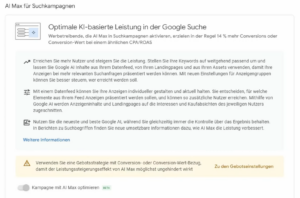
The entry point is deliberately low-threshold: in Google Ads Activate AI Max in the settings of an existing search campaign and select the functions, including Text Customization and Final URL Expansion. Google describes this process as Opt-in directly in the campaign, including downstream settings at ad group level. In agency practice, it is worth starting with experiments because Google AI-Max experiments offers and the Marketer This provides a basis for comparison. Think with Google also reports 27% more conversions with comparable CPA or ROAS when advertisers use AI Max.
- Activate AI Max in a stable search campaign and start an experiment to keep the comparison clean.
- Define Brand Controls and Locations of interest per ad group, so that the playout and environment fit.
- Check Text Customization with clear release rules: Claim modules, pricing policy, mandatory legal information.
- Control Final URL Expansion via landing page logic (categories, products, exclusions) so that traffic ends up where it converts.
- Read search terms and asset reports closely and transfer learnings into structure and creative.
Relevance, commerce, measurement
When ads are embedded more strongly in conversations, relevance counts twice: for the user and for the AI selection. In the commerce context, Google is announcing new formats such as Direct Offers and describes protocols that are intended to simplify checkout in AI mode. Offers, feeds, shipping rules and availability therefore become part of the ad logic, and the Marketer brings these topics together with budgets, bids and creatives. This becomes a binding playbook for feeds, bids and tracking for everyday agency work.
- Keep product data and landing pages up to date: clean categories, clear prices, structured content, stable loading times.
- Define creative boundaries: permitted statements, fixed exclusions, recurring statements, etc. Proof points from your own data.
- Rate search queries by Intent clustering and use them to build new ad groups - the Marketer remains the architect.
- Use experiments as a standard process to justify budget shifts and coordinate them internally.
- Measure impact via conversions and value signals, and consistently maintain these signals in Google Ads and Analytics.
FAQs about Google AI Max
How do Google Ads appear in AI Overviews?
Google displays ads for some of the search queries if there is commercial intent and suitable, high-quality ads are available. Ads within AI overviews also need to be relevant to the content of the respective overviews.
Is AI Max a separate campaign type in Google Ads?
AI Max is a Opt-in within existing search campaigns. Google mentions AI Max as a way to display ads in AI Overviews and in AI Mode (AI Mode ads are running as a US test).
Which AI Max functions control the brand and landing pages the most?
For brand and context, Google calls Brand Controls and Locations of interest. For landing pages Final URL Expansion central because it dynamically selects landing pages according to search intent and remains controllable via URL rules.
How does the Marketer test AI Max cleanly in the account?
With Google Ads Experiments, the Marketer AI Max against a control variant and decides on the basis of its own conversion and efficiency data. This allows the budget to be shifted gradually and with good reason.
What do Direct Offers in AI Mode mean for retailers?
Direct Offers is a pilot for exclusive discounts in AI Mode, played out in the appropriate shopping context. Plus the Universal Commerce Protocol (UCP) as the standard for checkout functions in AI-supported interfaces.