

What AI systems mean for search
The way we search for information is changing. Google used to give us a list of blue links. Today, we are increasingly getting direct answers summarized by systems such as ChatGPT or Perplexity.
This development is turning the rules of search engine optimization upside down. It's no longer just about ranking at number one. The new goal is to Source for the AI's response.
These new systems are based on Large Language Models (LLMs). They search the internet for reliable information to create dialog-oriented answers. One example of how AI is already being integrated into everyday working life is the Microsoft 365 Copilot.
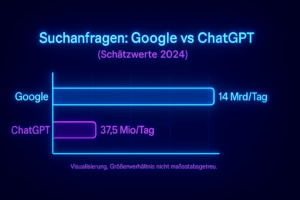
Even though Google, with over 90 % market share, the use of AI models is increasing rapidly. Estimates for 2024 assume that ChatGPT will already account for around 37.5 million search queries per day recorded. In comparison, Google has around 14 billion. These figures show a clear shift that every SEO strategy must adapt to.
How ChatGPT and Perplexity rate content
If you want to be visible in systems such as ChatGPT and Perplexity, you have to rethink. Pure optimization for keywords, as we know it from classic SEO, is not enough here. These new AI models evaluate content differently. Their aim is to find the one, absolutely trustworthy and precise answer to a user's question.
Two things in particular play a role here: authority and the quality of the information. Content must not only be technically correct, but also clear and comprehensible. One technical factor that helps here is Structured data.
The value of structured data
Structured data, which is usually integrated via Schema.org, provides the AI with the necessary context. Without it, the AI would have to laboriously derive the context from the text. You translate the content of your website into a language that machines understand immediately and unambiguously.
This helps the AI to correctly classify important elements such as people, places or products and to better assess the relevance of the information. A solid foundation for the LLM Visibility is hardly conceivable without clean, structured data. You can find out more about this topic in our guide to AI visibility.
Practical strategies for your LLM visibility
Classic SEO is no longer enough to appear in the responses of AI systems such as ChatGPT or Perplexity. You need to position your content specifically as a reliable, citable source. It's about signaling authority and trust not only for Google, but also for the algorithms of the language models.
An effective method for this is to create content in a question-and-answer format. Think about what specific questions your target group is asking and provide precise and direct answers. Clear, well-structured information is well received by LLMs.
Unique data and strong author signals
What makes your content particularly valuable for an AI? Information that they won't find anywhere else. Offer unique data, your own study results or exclusive insights from your practice. This makes your website an irreplaceable source.
Just as important are strong E-E-A-T signals (Experience, Expertise, Authoritativeness, Trustworthiness). Maintain your „About us“ page and create detailed author profiles. Clearly show who is behind the content and what expertise this person brings to the table.
E-E-A-T is no longer just a Google concept. LLMs are also looking for signals that underpin the credibility of a source. Strong author profiles and a transparent company presentation are therefore essential for visibility in AI responses.
How ChatGPT becomes your SEO tool
Instead of just optimizing content for search engines, we can also turn the tables. ChatGPT is a useful tool, which can speed up and improve many SEO tasks. If you use it correctly, you gain efficiency.
Think of all the small, time-consuming tasks: Keyword research, drafting outlines, copywriting meta titles or creating schema markups. All of this can be almost automated with specific instructions, known as prompts.
Prompts that work in practice
A good prompt is the key. It must be clear, precise and full of context. A vague question like „Give me keywords“ leads nowhere. It needs more detail.
Here are two examples of how you can do it in everyday life:
- For keyword research: „Create a list of 10 long-tail keywords for a blog article on the topic of ‚sustainable coffee beans‘. The target audience is environmentally conscious coffee drinkers in Germany who are looking for specialty products online.“
- For meta descriptions: „Write three different variants for a meta description (maximum 155 characters) for an article entitled ‚The best hiking trails in the Harz Mountains for families with children‘.“
The popularity of ChatGPT is also clear in Germany. Worldwide, the site recorded in May 2024 5.5 billion visits. Although there are no precise figures for Germany, the influence on information searches is noticeable. More about the global ChatGPT statistics can be found at electroiq.com.
The ability to use AI as a tool is becoming increasingly important for success in SEO. If you want to learn more about the connection between Google and artificial intelligence you will find details in our further article.
Measuring the results: How do you test success in the AI age?
How do you know if your efforts to improve visibility in language models are working? Traditional metrics such as rankings or click-through rates only tell half the story. Measuring success in the context of SEO for ChatGPT is still in its infancy, but new paths are emerging.
One strong indication is the increase in direct brand searches. Imagine your brand is repeatedly mentioned as a reliable source in AI responses. Users then start searching for you specifically. You can track this increase in branded search queries in the Google Search Console.
New metrics and tools
The first specialized tools are beginning to specifically record how often a brand appears in the responses of systems such as ChatGPT. This key figure - the Brand mentions in AI responses - will play a central role in the future. It is no longer just about generating fast traffic. The new goal is to be anchored as an authority in the „memory“ of AI and therefore also of users.
The focus is shifting away from pure click numbers towards qualitative presence. The aim is to become the first and most trustworthy answer to a question - regardless of whether it is asked by a human or a machine.
Search is changing. Topics such as multimodal searches, in which text, images and voice are combined, are coming more to the fore. A flexible strategy is therefore important, similar to optimization in e-commerce. You can find out more in our article on this topic SEO for online stores. In the end, SEO remains what it has always been: a continuous process of adaptation.
FAQs on SEO and ChatGPT
Is it even possible to do SEO for ChatGPT?
Yes, but it's a different approach to traditional Google SEO. Instead of aiming for position 1 for a keyword, it is about trusted source for the AI's answers to become.
This is not achieved with old SEO tricks, but with excellent, clearly structured content and strong authority signals (keyword E-E-A-T). Basically, it's about the AI seeing you as an expert on a topic.
What content works best for LLMs?
Content that provides clear answers to specific questions is very valuable. Anything that explains complex topics simply or offers unique data has an advantage.
Formats such as detailed FAQs, glossaries or detailed instructions are well suited because AIs can easily process the information in them and use it as facts.
The key idea is longevity. Good content that has made it into the knowledge base of an AI can serve as a source there for years and consolidate your authority.
Will AI search soon replace classic Google search?
Not at the moment. Systems such as ChatGPT or Perplexity are more of a supplement and change how we search - but they don't completely replace Google. There are indications that we will use both systems in parallel in the future. A good SEO strategy must therefore take both channels into account.
SEO is not a one-off task, but an ongoing process that adapts to new technologies. Find out more about why SEO is not a one-off project is.
How do I measure my success with ChatGPT optimization?
That is the tricky question, because direct measurement is still difficult. But there are good indirect signals. One strong indicator, for example, is the increase in „Branded search queries. If more people are searching for your brand directly, it may be a sign that they have come across you in AI responses.
At the same time, the first specialized tools are coming onto the market that are starting to capture mentions in AI responses. The field is developing very quickly here.