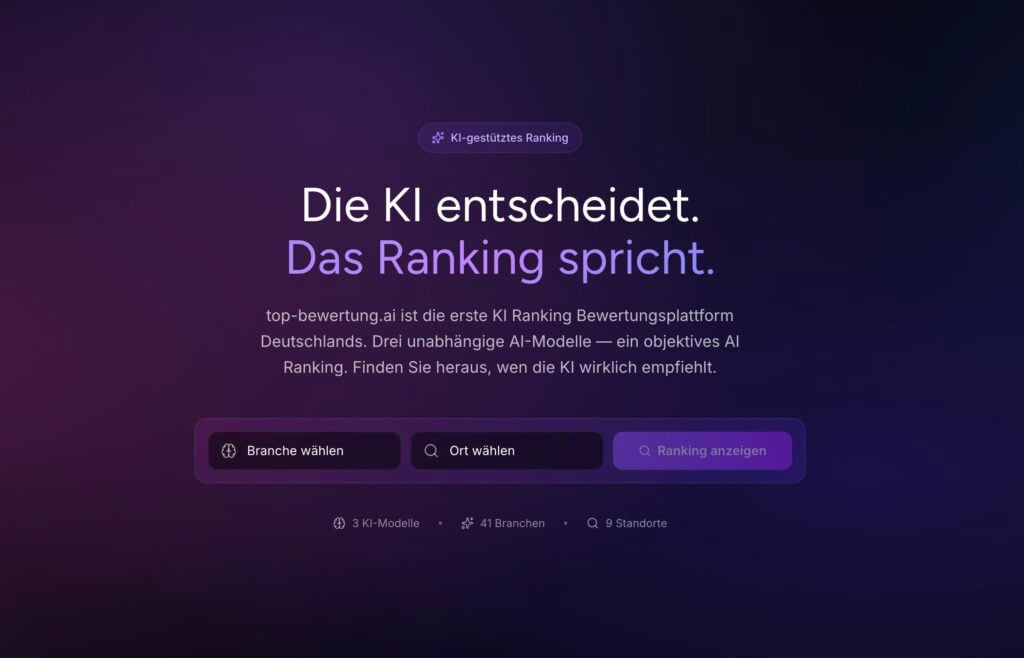


More and more people are no longer asking Google, but ChatGPT or Gemini: “Who is the best provider for …?” This is not only changing the way we search – it is also raising the question of who we actually trust when it comes to recommendations. With Top-Bewertung.ai, CSW.AGENCY uses the example of multi-AI consensus to demonstrate what a ranking might look like that is based not on editorial opinion, but on the judgement of three independent AI systems.
The search for providers is shifting towards AI
Just a few years ago, the search for a service provider almost always began in the same way: you’d type a search term into Google and work your way through the top results. Today, this first step is looking increasingly different. Users ask their question directly to an AI assistant – “Which SEO agency in Düsseldorf would you recommend?” – and expect a ready-made answer rather than a list of links.
This shift is not a marginal phenomenon. It affects the entire mechanics of online visibility. Generative responses are replacing the classic blue link, AI overviews appear directly above the organic results, and Google’s AI Mode is making conversation with the search engine the norm. Anyone who wants to be found in this environment must no longer focus solely on traditional ranking, but on AI search engine optimisation – visibility within the responses of the language models themselves.
This is precisely where a new question arises: if AI decides which providers to recommend – on what basis does it actually do so?
The problem with rankings as we know them
Comparison and review sites have long been part of everyday life for consumers. Yet trust in them is crumbling – for three understandable reasons:
- Lack of transparency in methodology. How a ranking is compiled usually remains a mystery. It is virtually impossible for outsiders to verify who is in first place and why.
- Paid placements without clear labelling. On many portals, a top spot can simply be bought – without the user realising it at first glance.
- Subjective editorial judgements. Where people rank providers editorially, personal taste, time pressure and conflicts of interest inevitably come into play.
Added to this is a rather technical problem: anyone who simply asks an AI model for the best providers receives the perspective of that one specific model – including its blind spots and its specific training bias. A single AI query is convenient, but it is not an objective authority.
There is no doubt that reviews and reputation have enormous leverage – we have described elsewhere just how strongly online reviews influence perceptions of a company. This makes the question of how to make rankings more trustworthy all the more important.

The idea: three AIs instead of one
The approach behind Top-Bewertung.ai turns the principle on its head. Instead of relying on a single opinion – whether from an editorial team or a single model – the platform uses the consensus of three independent AI systems: Claude from Anthropic, ChatGPT from OpenAI and Gemini from Google.
The logic behind this is the same as that applied in science: a result reached by several independent evaluators is more reliable than the opinion of a single individual. If a company recommends only one of the three models, that is a weak signal. If all three recommend it independently of one another, that is a strong signal.

How the methodology works
Behind the term ‘consensus’ lies a clearly defined, multi-stage process:
- Phase 1 – Independent AI analysis. All three models are given the same evaluation task and analyse the market completely independently of one another. None of the systems knows the results of the others. Each produces its own top 10 list.
- Phase 2 – Weighted consensus. A consensus algorithm merges the three lists. Businesses mentioned by several models rise in the ranking – weighted according to frequency and position. The results are then enriched with verified data from Google Maps.
- Phase 3 – Transparent publication. The consolidated ranking is published alongside a public methodology protocol. This makes it possible to trace which AI system recommended which company and how the final ranking was determined.
Six criteria are taken into account in the assessment: online presence, customer reviews, qualifications, accessibility, industry relevance and public mentions.

Transparency as a principle, not a marketing promise
The key difference lies not only in the technology, but in the approach. At Top-Bewertung.ai, the principle is this: organic rankings cannot be bought or influenced. A company appears in the ranking because the AI models have recommended it – not because it has paid for it.
Paid listings do exist, but they are clearly labelled as such and neatly separated from the organic results. And every single ranking openly displays its methodology protocol. It is precisely this transparency that traditional portals so often lack.
“Anyone looking for the best service provider today doesn’t want the opinion of a single editor – they want verifiable facts. By having three leading AI systems carry out independent assessments and making the entire process transparent, we are creating a new foundation for trust in online rankings.”
— Christopher Schwab, founder of CSW.AGENCY and initiator of Top-Bewertung.ai
What this means for businesses
For businesses, this shifts the focus to a key question: it is no longer enough simply to rank highly on Google. It is becoming increasingly crucial whether the leading AI systems recognise and recommend you. This visibility in AI response services such as ChatGPT, Gemini or Perplexity is becoming a discipline in its own right – we call it LLM SEO or optimisation for generative AI search (GEO).
A platform such as Top-Bewertung.ai makes this mechanism tangible: anyone who appears in an AI consensus ranking gains visibility in two ways – in traditional search results and in the responses from language models. An optional, publicly verifiable quality seal can also be embedded on a company’s own website, creating a further sign of trust.
The platform in figures
Top-Bewertung.ai is not just a concept paper; it’s live. The platform already covers a broad range of categories and is constantly being expanded:

The rankings range from tax advisers and tradespeople to digital and GEO agencies, covering cities such as Düsseldorf, Cologne, Frankfurt, Hamburg, Munich and Berlin, as well as Germany-wide comparisons. Featured placements for businesses start at €99 per month – this does not affect the organic rankings.
Conclusion: Trust is built on transparency
The way people search for providers is undergoing a fundamental shift – and with it, the question of whom they trust for recommendations. Multi-AI consensus offers a compelling answer to this: it replaces subjective individual opinions with a transparent, tamper-proof process.
For businesses, this means that anyone wishing to be visible in AI-powered searches should take a strategic approach to the issue today. As a specialist AI agency and AI consultancy based in Düsseldorf, CSW.AGENCY is supporting precisely this transformation – from SEO strategy through artificial intelligence to performance marketing.
Would you like to increase your visibility in AI search results? Tell us about your project in a no-obligation project enquiry – or see for yourself at top-bewertung.ai and take a look at our publicly available methodology.