


At the Reputation Online Management is about managing the public perception of your company or person online in a targeted manner. It is an active process in which you proactively build a positive digital footprint and at the same time are prepared for an emergency - i.e. negative comments or a crisis.
Why your online reputation should not be a coincidence
Your digital business card often determines whether a potential customer trusts you. This is about far more than just a few rating stars; it is the basis for your business success. This is precisely why actively managing your online reputation is not a minor matter, but a necessity.
Even a single negative comment can influence the purchasing decision of a new customer. Conversely, a positive reputation is not just a buffer against crises, but a real driver for customer acquisition. Ultimately, your digital reputation is directly linked to your sales.
A good reputation acts like a protective shield. It strengthens trust in your brand and makes your company more resistant to unforeseen criticism.
Actively cultivating this reputation is one of the smartest business decisions you can make. It ensures that the image that is painted of you online corresponds to the quality of your work. An important role here is played by Authenticity in marketing, because real trust cannot be forced. It grows when your actions and your communication form a unit.
Where do you really stand? Time for an honest reputation analysis
Before you can improve your online reputation, you need to know where you stand. An honest assessment is the basis for any sensible strategy in the Reputation Online Management. So the first step is to systematically record what is being said about your company and how.
To do this, search review portals, social networks and the specialist forums relevant to your industry. Find out which topics dominate in connection with your brand and - very importantly - what the prevailing mood is. It's about separating the relevant feedback from the irrelevant noise and recognizing patterns.
A simple monitoring dashboard can help you keep an eye on the most important channels and record public perception at a glance. This allows you to see immediately where action is needed.
Such tools not only show you, what is said, but also, where the important discussions take place. This is crucial for setting priorities.
Tip from the field: Don't just count the mentions. Evaluate their reach and influence. A single negative comment in an influential industry blog can weigh more than ten casual remarks in a small forum.
The importance of this topic is also reflected in the market: the value of Internet reputation management in Germany is expected to increase from 50.3 million US dollars in 2025 to over 212 million US dollars will grow by 2035. You can find out more about this growth in this analysis by Future Market Insights.
Incidentally, a Backlink analysis provide valuable information. It shows which external sites refer to you and thus help to shape your reputation - both positively and negatively. We as SEO Agency Düsseldorf will be happy to support you.
Overview of analysis areas for online reputation management
For a comprehensive analysis, you should keep an eye on the right channels. This table gives you an overview of where you should start and which key figures count.
| Platform/channel | Important metrics | Analysis focus |
|---|---|---|
| Google search results | Rankings for brand keywords, first page content, Google Alerts | What is the first thing potential customers see? Are there any negative headlines or reviews? |
| Rating portals | Star rating, number of reviews, tonality of comments | What is the average level of customer satisfaction? Which points of criticism occur repeatedly? |
| Social networks | Mentions (mentions), engagement rate, follower growth, sentiment | How is the brand talked about? What content generates positive or negative reactions? |
| Blogs & Forums | Reach of the platform, authority of the author, context of the mention | Where do the relevant industry discussions take place? Who are the opinion leaders? |
| Press & News pages | Number of articles, tone of reporting, reach of the media | How is the company presented to the public? Is there potential for crisis? |
If you systematically check these areas, you will get a clear picture of your current online reputation and can plan the next steps in your strategy.
From the status quo to a clear strategy
Once the initial situation has been established, the next steps must be systematically addressed. The Circulation shows you how to proceed:
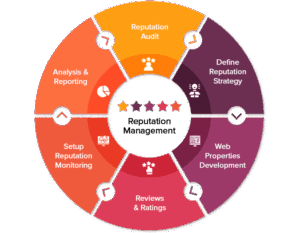
Proactively create positive content
Don't wait for others to talk about you. Take matters into your own hands and proactively create content that showcases your expertise and contributes positively to your image. This could be blog articles, case studies or authentic customer testimonials. A well-positioned Online marketing strategy then ensures that these positive signals are also found by potential customers.
A robust strategy for your reputation goes one step further. It integrates aspects such as governance, risk and compliance (GRC) for business resilience to prevent risks and build trust from the ground up.
At the same time, you should establish a simple system with which you can continuously collect customer feedback. Make it as easy as possible for your satisfied customers to leave a positive review. Because authentic praise from real people is the most effective advertising for your good reputation.
Respond professionally to reviews and feedback
Customer feedback, especially in the form of online reviews, is valuable for your Reputation Online Management. Every review is an opportunity to show publicly how much you value your customers and how professionally you deal with praise and criticism. A quick, thoughtful response is therefore not a chore, but active brand management.
Take the time to respond to both positive and negative comments. In the case of praise, a simple but personal thank you is often enough. When it comes to criticism, you can show what you are made of: remain objective, show understanding and - if appropriate - offer a solution.
Dealing with negative and manipulated reviews
Negative reviews are not the end of the world. Handled correctly, they can even be useful. How exactly you can use bad ratings to their advantage, we have already explained in another article. It's about learning from criticism and publicly demonstrating that you take feedback seriously.
Consider every negative review as free business advice. It shows you directly where there is potential for improvement and what is bothering your customers.
The figures speak for themselves: in 2024, trust in the 42 % of German consumers rate online reviews just as highly as personal recommendations. At the same time 92 % of users only rate companies with at least four stars. A single negative review can cost you up to 30 potential customers. Detailed insights into this You can find statistics on online reputation management here.
Take precautions and act correctly in crises
An online crisis rarely announces itself. It usually occurs unexpectedly. This is precisely why solid preparation for your Reputation Online Management Mandatory. If you only act when the digital storm is already raging, you will only be left behind. It's all about keeping an eye on potential risks and having a clear plan ready before things get dicey.
Such an emergency plan is not a dusty manual, but a concrete, lean instruction. It clearly regulates who is responsible if there are problems and what steps need to be taken immediately.
A crisis team and clear rules
Put together a small, effective crisis team. This includes people who can make decisions quickly - usually a mixture of management, marketing and customer service.
Clear communication guidelines are just as important:
- Speed is crucial: An initial, honest response must be made within a few hours. Silence on the internet quickly comes across as an admission of guilt.
- Transparency creates trust: Be open about what is going on and what you are doing now to solve the problem. Embellishing phrases are out of place here.
- Speak with one voice: Everyone in the team must convey the same message to the outside world. Contradictory statements only fuel the rumor mill and damage credibility.
Act quickly, but don't panic. Transparent, honest and empathetic communication is the key to regaining your customers' trust and limiting the damage.
Measure success and optimize your strategy
Good Reputation Online Management is not a one-off project, but an ongoing process. To know whether your measures are working, you need to make success measurable. This is the only way you can adapt your strategy in a targeted manner and improve.
Concentrate on key performance indicators (KPIs) that are truly meaningful. The mere number of mentions is often not very meaningful - the quality behind it is more important.
Keeping an eye on relevant key figures
Here are some of the most important metrics you should check regularly:
- Sentiment analysis: How has the general mood developed in the online conversations about your brand? Are there more positive or neutral comments?
- Average star rating: Is the cut on important portals such as Google or industry-specific platforms increasing?
- Visibility in search engines: Where do you stand for your own brand name? Are the initial results positive and controlled by you?
- Commitment with positive content: How often is your positive content - for example case studies or expert articles - shared or commented on?
Specialized software can simplify this monitoring process. The market for such tools is large: in Germany alone, it is expected to grow to around 5.5 billion US dollars appreciated. You can find out more about the functions of these programs in this market report from Verified Market Reports.
The best data is useless if you don't draw any conclusions from it. Do you recognize a pattern in negative comments? Customize your service. Do you see that certain content is well received? Produce more of it.
Analyzing this data not only helps you to protect your reputation. Increased trust often has a direct impact on your business and can increase Conversion rate optimization as convinced customers buy more quickly.
Frequently asked questions about online reputation management
Finally, we clarify some of the most frequently asked questions about the Reputation Online Management.
What is the first step in online reputation management?
The first step is a Thorough inventory your digital presence: you identify, where and how your brand is talked about, analyze the tonality, frequency and influence of mentions and create a ranking analysis for your brand keywords.
How long does it take to suppress negative content?
This depends on many factors (ranking, domain authority, competition), but often it takes several months to a year, to displace negative content on page 1 and bring positive content to the top.
Can I have negative reviews deleted?
Not always - it depends on the provider and their guidelines. Only if a review violates rules (e.g. defamation, data protection, offensive content) can it be removed. In other cases, the more sensible course of action is to remove it, encourage positive feedback and respond to it more transparently.
How do I react optimally to negative reviews?
Respond objectively, empathetically and as solution-oriented as possible. Thank them, acknowledge the problem, apologize if necessary, explain how you intend to avoid it in the future and offer to clarify it offline. This is how you show professionalism in public.
How do you measure the success of reputation management?
Set clear goals from the start (e.g. ranking positions, average rating, sentiment score). Regularly compare actual vs. target. Metrics such as reach, engagement, search result rankings or improvement in ratings provide measurable indicators.