

Three weeks, three headlines: launch on 9 June, export ban on 12 June, comeback on 1 July. Rarely has an AI release generated such a stir, even by the standards of an industry that thrives on announcements. Behind all the hype lies a model that works autonomously for hours on end, delivering results that previously required entire teams. It’s time for a sober look at what Fable 5 can actually do and how it can help you in your day-to-day business.
What’s behind Fable 5 and Mythos 5
Fable 5 is the first generally available Mythos-class model, a new performance tier above the existing Opus series within the Claude AI model family. According to Anthropic, the model achieves top scores on almost all benchmarks tested, including software development, knowledge work and image processing. The longer and more complex the task, the more pronounced the gap becomes compared to smaller models. At the payment service provider Stripe, Fable 5 completed a code migration in a codebase of 50 million lines in a single day during Early Access – a task that would otherwise have taken an entire team more than two months – which is quite a feat.
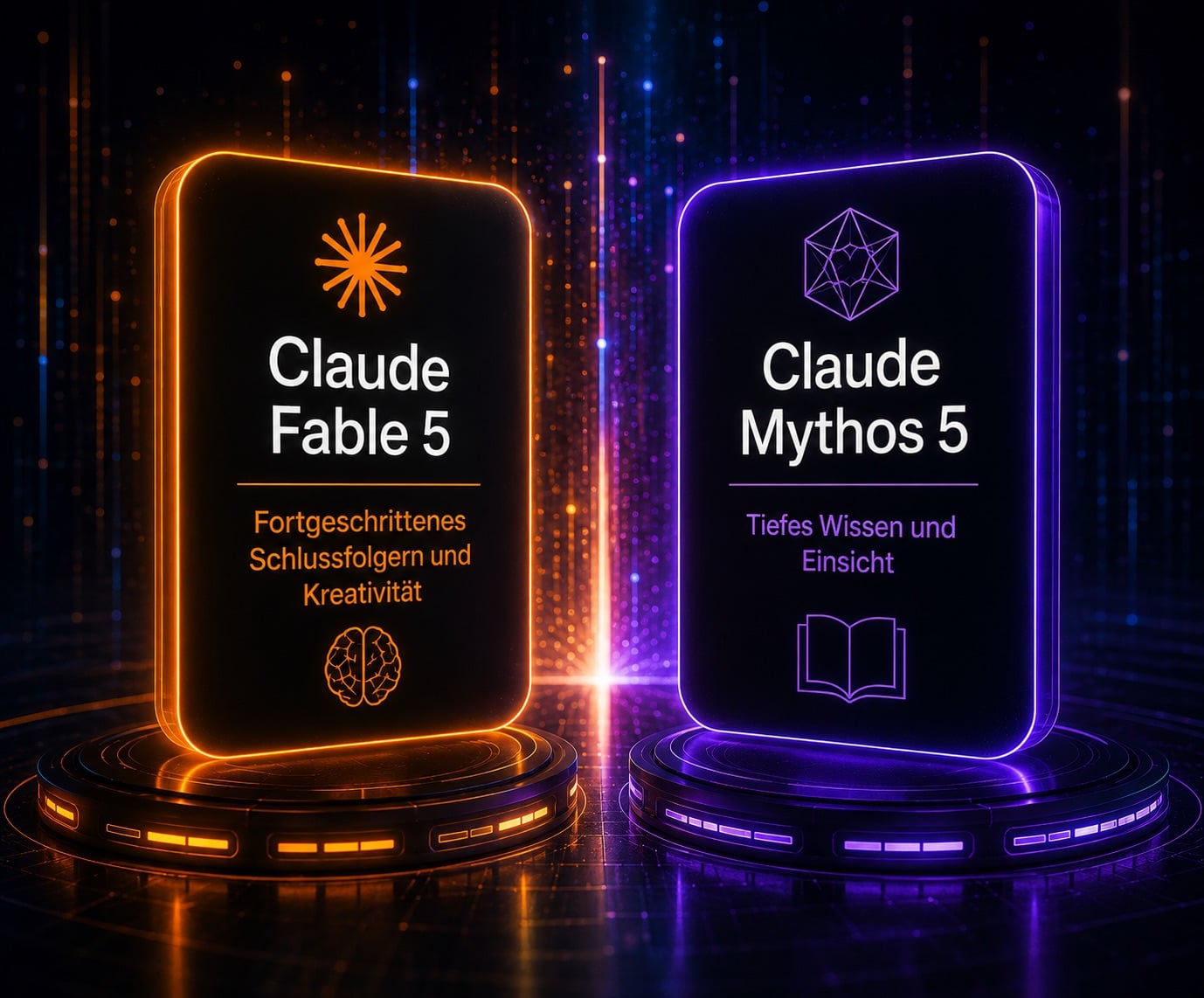
What sets this model apart are its safeguards: upstream classifiers check every query, and for topics such as cybersecurity, biology and chemistry, or model distillation, the next-smallest model, Claude Opus 4.8, automatically provides the response. On average, this affects less than 5 per cent of all sessions. Claude Mythos 5 is the same model without the cyber protection layer and remains reserved for verified security partners in the US programme Project Glasswing. In terms of pricing, both models cost US$10 per million input tokens and US$50 per million output tokens – less than half the price of its predecessor, Mythos Preview.
Export ban and comeback in three weeks’ time
Things got turbulent shortly after the launch. TechCrunch pointedly noted that Anthropic had publicly warned of the risks posed by increasingly powerful AI systems just days before the launch. On 12 June, the US government imposed export controls on both models, and Anthropic suspended access entirely. According to CNBC, the restrictions were lifted on 30 June, and Fable 5 has been available worldwide again since 1 July.
Fable 5 is available via the Claude API as well as via Amazon Bedrock, Google Cloud and Microsoft Foundry; within Claude subscriptions, the model is being rolled out gradually depending on capacity. There’s one new feature you should bear in mind: Mythos-class models are subject to a mandatory 30-day data retention period. Anthropic uses this data exclusively to defend against attacks and new jailbreak methods, logs every instance of human access, and subsequently deletes the data. Your content remains off-limits for training new models.
Here’s how you can put it to use in your business
The most exciting feature for day-to-day business is its endurance. Fable 5 operates autonomously as an AI agent for hours on end, keeping track of millions of tokens of context whilst refining its progress with its own notes. This brings tasks within reach that previously regularly failed due to loss of context or hallucinations. Four key areas of application stand out in the case studies from the launch partners:
- Code modernisation: Migrations and refactorings in large, legacy systems – which have been put off internally for years – can now be implemented in days rather than months. Both GitHub and Cursor report that the model handles complex programming tasks with a high degree of reliability, completing them in one go.
- Knowledge work: The model analyses extensive documents, tables and diagrams, providing transparent reasoning – for example, for financial analyses or competitive comparisons. On the Finance Benchmark by provider Hebbia, Fable 5 achieved the highest score of all models tested.
- Agent-based workflows: Multi-stage processes – from research through analysis to final implementation – run with significantly fewer intermediate checks, for example in environments such as Claude Cowork. Persistent file memory ensures that even projects lasting several days retain their overall coherence.
- Visual tasks: The model can accurately extract numbers from graphics and even recreate entire applications using only screenshots. This makes it particularly useful for reporting and quality assurance.
How to get off to a good start with Fable 5
The race between providers continues, as last year’s hype surrounding ChatGPT-5 has already shown. A robust testing process will take you further than simply jumping from one release to the next: identify the areas where generative AI measurably saves time in your workflows, and test new models against your existing setup in precisely those areas. Be realistic in your calculations, because at US$50 per million output tokens, your investment needs to be well planned. These steps have proven their worth:
- Prioritise use cases: Start with processes that involve a lot of manual work and where the results can be easily verified. Legacy internal code or recurring analyses are better suited than customer-critical processes.
- Set up a pilot: A scoped project with defined success criteria provides a solid basis for decision-making after just a few weeks. Make sure to note how much follow-up work the results actually require.
- Monitor costs: Measure token consumption per task and compare it with the labour costs of your current solution. Only this comparison will show whether the premium model is cost-effective compared to cheaper alternatives.
- Check data protection: The 30-day data retention period must be included in your data protection assessment and in contracts with service providers before the rollout. Also clarify which categories of data may actually be transmitted to the model.
FAQs on Claude Fable 5
What is Claude Fable 5?
Claude Fable 5 is an AI model from Anthropic, released on 9 June 2026, and was the first Mythos-class model to become generally available. It achieves top scores on almost all standard benchmarks and is designed for long, autonomous tasks. It excels particularly in software development, knowledge work and image processing.
How do Fable 5 and Mythos 5 differ?
Both are based on the same model. Fable 5 includes security filters that forward sensitive queries to Claude Opus 4.8, whilst Mythos 5, without this layer of cyber protection, is exclusively available to vetted partners in the Project Glasswing programme. Fable 5 is therefore the relevant version for standard business use.
How much does Claude Fable 5 cost?
Via the Claude API, Fable 5 costs ten US dollars per million input tokens and 50 US dollars per million output tokens. This is less than half the price of Claude Mythos Preview, the first Mythos-class model. In the Claude subscriptions, the model will be gradually rolled out depending on available capacity.
Why was Claude Fable 5 temporarily suspended?
On 12 June 2026, the US government imposed export controls on Fable 5 and Mythos 5, following which Anthropic suspended access. The restrictions were lifted on 30 June, and the model has been available for use worldwide since 1 July 2026. The restrictions were imposed due to concerns about uncontrolled access to the new model capabilities from abroad.
How secure is Claude Fable 5?
Upstream classifiers automatically route enquiries relating to cybersecurity, biology, chemistry and distillation to Claude Opus 4.8. In a bug bounty programme, the system remained free of a universal jailbreak for over 1,000 test hours. On average, the filters are triggered in less than 5 per cent of all sessions.