
What GAIO SEO means for your visibility
The way we search online is changing. Instead of clicking through a list of links, users are increasingly receiving a direct answer summarized by an AI. If your content is not optimized for this new way of searching for information, you risk becoming invisible.
GAIO is therefore not a completely new discipline. It is the logical evolution of classic search engine optimization. The goal is shifting: it's no longer just about being at the top of the blue links, it's about it, Part of the direct AI response to become. Your expertise then flows directly into the conversation that the user has with the AI.
This adaptation is crucial if you want to be found online in the future. It ensures your visibility in a world in which answers are increasingly found through dialog rather than clicks.
GAIO ensures that your brand not only exists as a link, but is cited as an authority directly in the responses of AI systems.
For companies, this means they have to create content that
- provide clear answers to complex questions,
- are fact-based and well-structured so that machines can easily understand and use them.
- radiate thematic depth and trustworthiness.
Optimization for generative AI responses is now a central component of modern AI search engine optimization and ensures that you are well positioned for the next generation of search.
The difference between classic SEO and GAIO
Anyone involved in search engine optimization today is asking themselves a question: Is what we used to know as „SEO“ still enough? The short answer is: not quite. With GAIO comes a new approach that changes the rules of the game.
The core difference between classic search engine optimization and GAIO SEO is at the finish line. Traditional SEO is a race for the best ranking. The goal is clear: your website should be at the top of the list of Google results so that someone clicks on it. The click is the currency.
With GAIO, this focus shifts. It is no longer just about appearing in a list. The new goal is to go straight to the Answer to become. Your content should therefore be so convincing that the AI not only links to it as a source, but also incorporates your expertise directly into the generated text and cites you as an authority.
A different approach
This change of goal requires a different approach. Traditional SEO focuses heavily on keywords, backlinks and technical optimization in order to score points in the ranking algorithm. Generative AI Optimization places another requirement in the foreground: your content must be the most reliable and clearest source of information on a topic for language models.
It is less about the position in a list and more about being perceived as a trustworthy authority whose knowledge is worth passing on directly.
The following graphic shows typical key figures that improve a good SEO strategy: organic traffic, click-through rate and bounce rate. These are the classic metrics for success.
SEO vs. GAIO in direct comparison
A comparison helps to make the differences more tangible. The following table shows where the two disciplines focus.
| Feature | Traditional SEO | GAIO (Generative AI Optimization) |
|---|---|---|
| Primary goal | High ranking in the search results (Top 10) | Direct integration into AI-generated responses |
| Success metrics | Clicks, organic traffic, conversion rate | Visibility in AI responses, citations, brand presence |
| Focus of the content | Keyword optimization, fulfilment of the search intention | Factual correctness, clarity, E-E-A-T, structured data |
| Most important technology | On-page, off-page (backlinks), technical SEO | Semantic optimization, entity understanding, prompt adaptation |
| Role of AI | AI as a tool for analysis and content creation | AI as a target platform and information broker |
It is clear to see: GAIO does not replace traditional SEO, but builds on it and adds a new dimension. It is the logical development in a world in which search engines are increasingly becoming answer engines.
How an AI search processes information
To create content for GAIO SEO we need to understand how an AI search engine works. Think of AI as a very diligent research assistant. It searches the web, checks sources and formulates a new, coherent answer from the best information.
The AI is guided by certain signals. Similar to Google's E-E-A-T principle, authority, facts and depth of content are important. The AI is trained to find the most credible source in order to provide a helpful and correct answer. The ability of Google, artificial intelligence changes the rules of the game for the evaluation of content.
What the AI looks for in content
Clearly structured and easy-to-understand content is at the top of the list. AI prefers precise data, unambiguous statements and logical reasoning.
A key factor is trust. The AI compares information from many sources to check facts. Content that is cited or linked to by other recognized authorities is therefore given the benefit of the doubt.
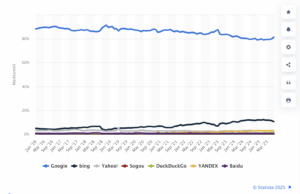
In Germany, Google has a market share of around 81.4 % set the tone (as of August 2025, see Statista). This dominance makes it all the more important to produce first-class, user-centric content that meets quality standards.
How do you put this into practice? Much of what you need for a successful GAIO SEO strategy is based on proven SEO principles. The difference is that these principles are now adapted specifically for the way language models work.
The most important lever here is your content. It must answer complex questions directly, comprehensively and based on facts. Imagine an AI searching for the perfect answer to a user question - your content must be this answer.
Designing content for man and machine
A clear structure is crucial here. Work with short paragraphs, meaningful subheadings (H2, H3) and lists to make your information easy to understand. This not only helps your readers, but also the AI crawlers to quickly grasp the key messages.
Building thematic authority is just as important. Instead of covering many topics superficially, focus on exploring a core topic from different angles. This signals expertise and is exactly what generative search engines are looking for. More on the general use of AI in marketing can be read here.
Remember: GAIO is all about Answer not just another source in a long list of search results.
Data and analyses as a compass
Analysis tools are necessary to control the success of your GAIO measures. Proven tools such as the Google Search Console help you to understand user behavior and find the right search terms. By keeping an eye on key figures such as organic traffic and keyword rankings, you can monitor the success of your Generative AI Optimization measure and adjust in a targeted manner.
How search is changing and the role of GAIO
The way we search for information online is at a turning point. However, AI-generated answers will not replace the classic list of blue links overnight. Instead, they will complement them. We are moving towards a hybrid search, where users will sometimes see a direct AI summary and sometimes the usual list of links - depending on what the search query requires.
GAIO SEO is not a short-lived trend. It is the logical evolution of digital visibility. The foundation of good content and clean technical SEO remains irreplaceable - this is the basis for any online success.
GAIO is the adaptation to a new reality in which your expertise is not only found, but directly cited by the search engine.
An adaptable strategy is needed to remain visible in both worlds - traditional and generative search. How closely these areas are already linked today is demonstrated by how AI systems such as ChatGPT for SEO can already be used in practice.
GAIO SEO: The most important questions in a nutshell
Finally, we clarify some of the most frequently asked questions about GAIO SEO.
Is GAIO replacing traditional SEO?
No. GAIO does not replace traditional search engine optimization, but builds on it. Traditional SEO is the foundation - technically clean and stable in terms of content. It doesn't work without this foundation.
GAIO is the extension that is specially optimized for the new AI search systems. Both disciplines work together to achieve the best possible visibility.
Is GAIO only for large companies?
No. GAIO is an opportunity for companies of all sizes. Especially niche providers or local specialists can build up a great authority through specific and high-quality content.
AI systems are looking for exactly that: in-depth knowledge. If your content offers this depth, you have a good chance of appearing in the generative answers, regardless of whether you are a corporation or an individual company. It all comes down to quality.
How can I measure the success of GAIO?
Success measurement at GAIO is still evolving. Instead of just looking at clicks, new metrics are taking center stage.
The decisive factor will be how often your brand is mentioned as a source in AI responses (Brand Mentions). The traffic that comes to your site after such a mention is also an important indicator. The first tools are already being developed that can record precisely these new key figures. You can also find further answers to general SEO questions in our FAQ section.