
In this article, we summarize the findings from the SEO community, research the background and provide practical recommendations. The Decrease in impressions in the Google Search Console is not a reason to panic, but a signal to understand the measurement methods and focus on the users.
Decline in impressions: What happened?
In mid-September 2025, Google made a small but momentous change: The option to retrieve 100 organic results per search page was abolished. Previously, you could add the parameter &num=100 and see a hundred results at once instead of ten. Many rank tracking tools used this function to quickly collect data from the results lists. Barry Schwartz pointed out that the parameter &num=100 no longer returns a hundred results. This means that tools have to run ten times more queries to obtain the same amount of data.
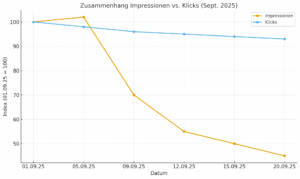
At the same time, many SEOs reported a significant drop in impressions in the GSC. Brodie Clark observed that the desktop impressions of many websites fell sharply, while the average position improved. The timing is striking: September 10, 2025 was the day Google stopped collecting 100 results and the GSC curves plummeted.
Why does the change have such an impact?
The key lies in the measurement process. Google counts an impression as soon as a search result is visible on the current page - even if no one scrolls to it. If rank trackers retrieve 100 results by default, the GSC also registers an impression for position 99. Brodie Clark explains that an impression is only recorded in the GSC if the result is displayed on the current page. Normal users see ten hits per page; tools with 100 hits per page therefore produce many bot-driven impressions.
After the abolition of &num=100 bots can no longer retrieve a hundred results at once. As a result, the impressions for positions 11 to 100 are no longer available. Consequently, the total number of impressions decreases, while the average position increases: Fewer „low ranking impressions“ shift the average upwards.
Clark also noted that the decline mainly affects desktop traffic because most rank trackers work on the desktop. Many suspect that Google is restricting scraping and cleansing the data in this way. Google itself has not yet confirmed this theory.
Effects on SEO tools and costs
The deactivation of the parameter not only affects the Search Console, but also many SEO tools. With &num=100 they could load 100 results with one request. Now ten queries are required - which multiplies the effort and costs. Some providers are already thinking about tracking only the top 20 results or adjusting their prices.
Tim Soulo from Ahrefs, for example, indicated that his tool could only evaluate the first two pages of results in future. As a result, there will be less data for positions beyond page 1 - but this is usually not dramatic. Most clicks are on the top 10 anyway, and positions outside the first two pages hardly generate any traffic. BrightLocal emphasizes that the real rankings remain unchanged and the top 10 will continue to be measured correctly.
Because data collection now requires ten times more requests, the operating costs of the tools are increasing noticeably. Observers such as Gagan Ghotra also see the change as an attempt to curb scraping and data misuse. Smaller providers are faced with the choice of accepting higher costs or changing their business model.
Bots versus humans - what does the data mean?
For a long time, many SEO analyses noted a growing gap between increasing impressions and stagnating clicks. Some attributed this development, known as „great decoupling“, to Google's AI overviews. Brodie Clark suspects that some of the additional impressions simply came from bots. If a tool retrieves results up to position 100, it generates numerous impressions without real users.
The Search Console has been providing more realistic data since mid-September. Practical Ecommerce points out that the dropped „impressions“ primarily concern URLs that bots have seen. The average position increases because only results up to 10th place are counted. Although the data basis for position 1 remains slightly distorted because bots continue to call up the first page, the effect is smaller.
It is important for website operators to know: Their rankings have not collapsed. Visibility remains the same and it is mainly a matter of adjusting the statistics. Nothing changes in the top 10; these positions deliver the majority of traffic. BrightLocal confirms that only the reported impressions decrease, but the real rankings remain the same.
Impressions vs. clicks - a visualization
What to do?
The Decrease in impressions in the Google Search Console may seem unsettling in the dashboard. In practice, little will change for your visitors. These steps help to classify the development:
Check data: Compare GSC figures with analytics or server logs. If visitor numbers are stable, the decline is a trade fair effect.
Focus on the top pages: Positions beyond the top 20 hardly bring any traffic. Concentrate on the first pages.
Observe CTR: Check the click rate. A drop in impressions with no change in clicks may even indicate a better focus on the target group.
Critically evaluate tools: Many rank trackers currently provide incomplete data. Use several sources and check which information is reliable.
Stay calm: It is to be expected that Google will continue to adapt its reporting methods. Quick reactions are rarely necessary.
Frequently asked questions
Why are the impressions suddenly dropping?
The decline is due to the abolition of the parameter &num=100 together. As a result, only ten instead of one hundred results are recorded per page; many bot-generated impressions are eliminated. The visitor data remains stable.
Does the drop in impressions affect my ranking?
No. This is an adjustment to the measurement. The top positions continue to be recorded correctly; the slump mainly affects bot-related impressions.
What to do if SEO tools no longer show rankings?
Many providers have to adapt their data queries because they can no longer read out 100 results at once. Check whether your tool offers an update and temporarily focus on the top 10 or top 20. Alternatively, you can use the GSC API or specialized tools.
Focus on the right metrics
The decline in impressions is not an alarm signal, but the result of a technical change at Google. By restricting the parameter &num=100 bot-based impressions in particular disappear from the statistics. This leads to a more realistic data basis, even if it causes confusion in the short term.
The following still applies to search engine optimization: Relevant content, clean technical implementation and a well thought-out keyword strategy remain key. Take the opportunity to critically scrutinize your data and focus on the metrics that really count - clicks, conversions and satisfied users. You can find more in-depth information in our articles on Backlink analysis and to the Expanding your AI visibility and on our services page as SEO Agency Düsseldorf.
Sources: