

Google is increasingly providing answers directly. AI overviews summarize at the top of the page, classic SERPs provide links. This shortens paths, shifts clicks and makes zero-click more likely. Here you can read about the difference in detail - with comparison, data and specific adjustments for SEO and content.
What are AI overviews and what are classic SERPs?
To understand what is changing in Google search, we need to briefly clarify the terms. The classic SERP is what we have known for years: a list of blue links, advertisements and small text excerpts that we click through ourselves and gather our own information. Self-research is the keyword here.
The new AI Overviews are different. They are AI-generated summaries that appear right at the top of the results page. Their aim is to answer the user's question immediately and conclusively.
The difference lies in the core: classic SERPs offer a selection of sources, while AI Overviews provide a ready-made answer. Especially on Mobile devices, where Google has a market share in Germany of over 90 % this is increasingly leading to so-called „zero-click“ searches. Users get their answer without even having to visit a website. Current data from luna-park.com confirm this trend.
This distinction is crucial in order to understand how user interaction with Google, and therefore the use of AI in marketing from the ground up.
Information search in direct comparison
Probably the biggest difference between the new AI Overviews and traditional search is how we find information - and how quickly this is done. The core of the whole thing is the type of search query.
For a simple factual question such as „height of the Zugspitze“, an AI Overview provides the answer in seconds directly above the organic results. The user journey here is very short and efficient: ask a question, read the answer, done. There is no need to click on a website.
The situation is completely different for more complex queries, for example when searching for the „best camera for beginners“. This is where the classic search results come into their own. In such cases, users don't just want a quick answer, they want to read various test reports, compare opinions and delve deeper into the subject matter. The user journey is much longer here and requires active research across multiple sources. The aim is to form an informed opinion of their own - a task that an AI summary can only fulfill to a limited extent.
Comparison: AI overviews vs. classic SERPs
To make the differences in user experience clearer, the following table compares key features of the two approaches.
| Criterion | AI Overviews | Classic SERPs |
|---|---|---|
| Response type | Direct, summarized answer | List with links to various sources |
| Speed | Very fast for simple facts | Requires clicks and further research |
| User journey | Short and direct | Longer, with several steps |
| Ideal for | Specific questions, definitions | Complex research, product comparisons |
| Interaction | Mostly passive consumption | Active research and comparison |
It is clear to see: AI Overviews are designed to immediately satisfy simple information needs, while traditional SERPs remain the first port of call for in-depth searches.
Click and abandonment rates with AI Overviews
The following values show how the behavior changes on the search results pages with AI summary.
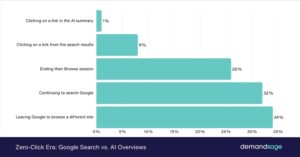
This shortens the path - and the decision, whether is clicked at all, more often falls directly on Google. The Diagram also makes it clear how AI overviews shift user behavior. Only 1 % click on a link in the AI summary and 8 % select a result at all. The majority end the search, switch to another website or simply continue searching on Google - a clear signal of the zero-click trend.
From click to conversation: How the user journey is changing
With AI Overviews, we are experiencing a fundamental reorganization of how users get from their question to the answer. The familiar, linear path - search query, click on a link, visit to the website - is slowly disappearing. Interactions are increasingly shifting directly to the Google results page.
This means that the classic user journey is not just getting shorter. It is changing from a pure click-based model to a kind of direct conversation with the search engine.
The whole thing reinforces the phenomenon of „zero-click searches“. If users get their answer directly in the AI overview, why should they click any further? This has direct consequences for website traffic and raises the question of how we will measure success in the future.
At the same time, the expectations of searchers are changing. Patience for long searches and clicks is dwindling, while the demand for immediate, precise answers is growing.
The Customer Journey is becoming more condensed and immediate. Companies must prepare their content in such a way that it is no longer just optimized for the click, but also as a building block for a direct answer can function in an AI summary.
Even though Google has a market share in Germany of around 91,98 % has a dominant position, specialized AI tools are also shaping user behavior. Anyone wishing to delve deeper into this change will find a current analysis of search engine usage on seranking.com interesting insights. Incidentally, this shift does not only affect the organic Rankings, but also has a noticeable impact on paid campaigns (Guide to Google Ads).
SEO and marketing in transition - time to adapt the strategy
The shift towards AI-supported responses from Google means a new direction for marketers. It's no longer just about getting people to click. The new goal is to appear directly in the AI Overviews as a trustworthy source to be quoted.
We need to broaden our focus - from individual keywords to semantic contexts and comprehensive answers to complex user questions. The content must be prepared in such a way that an AI recognizes and selects it as the relevant answer for an entire topic.
A nomination in the AI Overviews can Brand authority even if no direct click follows. Visibility in the response is the new ranking.
This development is driven by user behavior. For Germany, it is estimated that the market share of AI-supported search systems will be around 54,2 % will be the most popular, with AI web searches dominating. The younger generations in particular expect quick and precise answers instead of clicking through lists of links. More details on these AI statistics can be found in a comprehensive analysis on coherentmarketinsights.com.
Rethinking search and utilizing change
Who AI overviews against classic SERPs you quickly realize: one does not replace the other, it is rather a profound development. The days when SEO was primarily aimed at clicks are coming to an end. Instead, we must manage to appear as a trustworthy authority directly in the AI responses.
The key finding is simple: companies that understand what their target group needs and create content that provides precise and helpful answers will prevail. The focus is shifting away from individual keywords towards entire subject areas and clearly answering specific user questions.
Anyone who waits now will lose valuable time and the connection. This change is not a dream of the future, it is happening now. The key to success lies in actively shaping the new user journey and no longer just optimizing content for the click, but for direct mention in AI overviews.
Frequently asked questions about AI overviews vs. classic SERPs
Are traditional search results now disappearing completely?
No, that is very unlikely. Think of it more as a coexistence: Both systems have their justification and will play to their strengths depending on the search query.
AI Overviews are good for quick, fact-based answers. A simple question, a direct answer. But when it comes to complex research, forming your own opinion or detailed comparisons, users will continue to appreciate the variety of traditional search results. The task for marketers is to design content in such a way that it works in both worlds.
How can I optimize my content for AI Overviews?
The core is simple: Give clear and direct answers to your target group's questions. Solve the user's problem - precisely and without lengthy verbiage.
What also helps:
- Structure your content clean. Clear headings, lists and tables are valuable.
- Use structured data (Schema.org). This gives search engines the context they need to understand your information correctly.
- Build authority (the E-E-A-T principle). Google relies on sources it trusts for its AI answers. Be one of those sources.
If clicks go down, is SEO dead?
Not at all. But the goals of SEO are shifting. It's no longer just about driving as much traffic as possible to your own website. Pure brand presence directly in the search results is becoming increasingly important.
Having your brand or website mentioned in an AI Overview is a great trust and authority boost - even if no one clicks on it.
SEO is becoming more strategic as a result. The new goal is to be perceived as the one, reliable source for a specific topic. Visibility in the answer is the new ranking.