

How much does a website cost? Anything is possible, ranging from €50 a year to a six-figure sum, and both figures can be appropriate for the respective case. The price depends on three variables: the path you choose, the scope you need, and the hourly rate of the person building the site. Anyone who knows these three variables can evaluate any offer and negotiate with service providers on equal terms. The following figures come from official price lists, an industry survey, and our own calculation practice—each can be verified.
Three ways to your own website and their price tags
The cheapest way is the website builder. With WordPress.com, the Personal plan costs €9 per month with monthly billing and €4 per month with annual billing, the Business plan with plugin access is €40 or €25 per month (official price listYou build the site yourselves, pay no service provider hours, and get a design from the template catalog in return. For a business card on the web, that is enough, and your working time is the real price.
The middle way is a website on a CMS (Content Management System), mostly WordPress, built by a freelancer or an agency. Here you pay for your concept, design, implementation, and training, can manage content yourself afterward, and have technical freedom. The most expensive way is development without a ready-made system, which makes sense for custom applications, portals, or interfaces to ERP and CRM systems. The choice between these three paths depends on the scope of features you really need: anyone who wants to make appointments bookable, sell products, or transfer customer data will quickly reach the limits of a website builder. Anyone who needs a handful of pages with a contact form pays an agency for freedoms that remain unused.
How to calculate the price yourself
Every serious quote follows the same formula: effort in hours multiplied by the hourly rate. The median hourly rate for software and web development in Germany is, according to the Freelancer Compass 2026 by freelancermap at €90 — evaluated across by far the largest group of participants in the study. Agencies are higher because project management, quality assurance, and availability are factored into the price. Anyone who names a figure without quantifying the effort is selling an estimate as a price.
Let's calculate a typical corporate website with five pages, using effort from our project practice: concept and page structure 8 hours, design 20 hours, technical implementation 30 hours, content entry 10 hours, technology, testing, and launch 12 hours. That is 80 hours. At the median hourly rate, this comes to approximately 7.200 €. Anyone who asks how much a website costs will get a number instead of a gut feeling with this calculation. If you receive an offer of €1,500 for the same scope of services, either the effort has been calculated to be significantly lower or someone is charging €19 an hour. You should know both before signing.
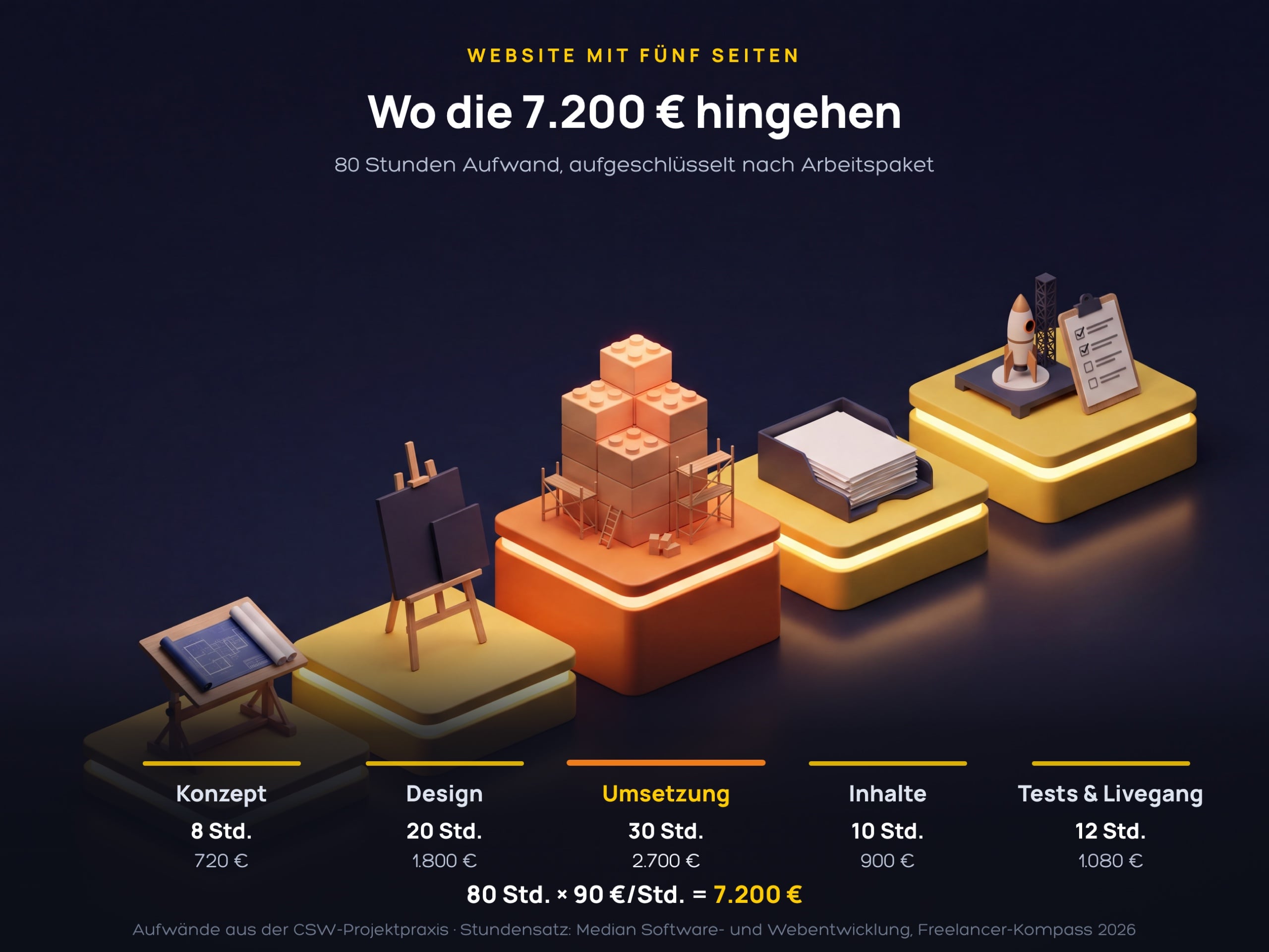
The breakdown shows why flat-rate pricing is of little help. The technical implementation is the largest block at 30 hours, while concept and content together account for less than a quarter of the total effort. Anyone wanting to save on the quote will therefore target the implementation, for instance with fewer custom modules — whereas anyone who saves on the concept is saving on the smallest item and risking the biggest.
These factors are driving the price up
The effort grows with the number of different components, rather than the page count. Ten pages made from the same four modules are built faster than three pages that are each uniquely designed. That is why it is worth counting the pages that truly require their own design before requesting a quote. Clients particularly often underestimate two requirements in the process, and both have been mandatory since 2025:
- Custom design instead of template — each module is designed, coordinated, and conceived separately for mobile devices
- Contents — Text, photos, and videos are separate trades; whoever does not supply them must purchase them
- Functions — Shop, booking funnel, login area, or interfaces multiply the testing effort
- Accessibility — the Accessibility Strengthening Act applies to e-commerce services from June 28, 2025; microenterprises with fewer than ten employees and an annual turnover or balance sheet total of no more than €2 million are exempt, and severe violations carry fines of up to €100,000 (Section 2 and Section 37 BFSG)
- Loading time and stability — Google states as good values a Largest Contentful Paint under 2.5 seconds, an Interaction to Next Paint under 200 milliseconds, and a Cumulative Layout Shift under 0.1; these Core Web Vitals achieved through optimization, not by chance
- Migration — smoothly carrying over existing content, redirects, and rankings is a separate work package, as our Best Practices for a Website Relaunch show
What the website costs after launch
The launch is not the end of the costs. A website is software: it runs on rented infrastructure, its building blocks receive security updates, and its content becomes outdated. Anyone who doesn't budget for this item in the first year will pay for it later as a repair—recovering a hacked WordPress site costs more than twelve months of maintenance. Therefore, ask about the annual costs when requesting a quote, not just upon launch. Budget firmly for these recurring items:
- Hosting and domain — Basis of operation, depending on visitor numbers and requirements for backup and support
- Licenses — Premium plugins, fonts, images, and security tools are renewed annually
- Maintenance - System and extension updates, plus backups and regular restoration tests
- Further development — new content, additional pages, measurement, and refinement of what generates inquiries
Right here is where it is decided whether the investment works. A website for €7,200 that remains untouched for three years ends up being more expensive than one for €12,000 that generates inquiries every month. If you need a reliable framework for your project instead of a range, we will calculate it as Web design agency Düsseldorf Let's get specific — with effort estimates per work package, transparently item by item.
FAQs regarding website costs
How much does a website cost with a website builder?
Between €48 and €480 a year, depending on the plan and payment method. At WordPress.com, the Personal plan costs €4 per month with annual payment and €9 per month with monthly billing, while the Business plan costs €25 and €40 per month, respectively. Your own working time for setup and maintenance must be added to this.
How much does a simple website with five pages cost?
Around €7,200 if a service provider builds it. The calculation: about 80 hours of effort for concept, design, implementation, content, and launch, multiplied by the median hourly rate of €90 for software and web development according to the 2026 Freelancer Compass. The value shifts up or down depending on the design requirements and the hourly rate.
What ongoing costs apply after launch?
Hosting, domain, extension licenses, maintenance, and backups. These items recur every year and are independent of whether the website is being updated or remains static. Anyone who further develops content also plans for an hourly quota.
Why are quotes for the same website so different?
Because different efforts and hourly rates are behind the numbers. Have every quote broken down into work packages with the number of hours. Only then are two quotes comparable, and you will see which service is missing in the cheaper quote — usually, it is the concept, testing, and training on the system.
Does my website have to be accessible as of 2025?
Yes, if you offer electronic commerce services to consumers — the Accessibility Strength Act has been in effect since June 28, 2025. Exempt are micro-enterprises with fewer than ten employees and an annual turnover or balance sheet total of no more than €2 million. In the event of serious violations, Section 37 BFSG provides for fines of up to €100,000.