

According to Gartner the traditional search volume will fall by 25 percent by 2026 - AI-generated answers will take over a growing share of the information supply. Google AI Overviews, Perplexity and ChatGPT Search select sources independently without a user having to click on a website. Anyone who appears in these systems as a citation-worthy source gains visibility on a channel that is currently growing massively.
What AI search does to traditional ranking
Google AI Overviews - until mid-2024 as SBU summarizes search queries directly on the results page and links to selected sources. The decisive difference to the classic search: the user gets the answer without having to visit the page. For publishers, this means declining click-through rates while at the same time increasing the importance of citation value. Presence in AI responses is the new first page.
Good news for all those who want solid SEO operate: According to Search Engine Land 99 percent of citations in Google AI Overviews come from organic top 10 results. Classic ranking remains the basis - but it is no longer enough on its own. AI systems also prioritize content according to factual density, structure and demonstrable expertise. A text that ranks well but is thin in terms of content is cited less often than a precise, well-supported article in position five.
Topical Authority as a new relevance signal
Topical Authority describes the thematic depth and breadth with which a website covers a topic. Search engines - and increasingly also AI systems - no longer just evaluate individual pages, but the entire thematic profile of a domain. A website that examines a topic from different angles, consistently links internally and publishes regularly sends out stronger relevance signals than a website with a single, well-optimized article.
This has a direct impact on the Content strategyThinking topic complexes through to the end is more important than covering as many individual keywords as possible. A Pillar articles on the main topic, flanked by thematically related cluster articles, is more stable than ten isolated texts without a contextual link. Ahrefs shows in several studies that domains with high Topical Authority rank faster - even for new content without Backlink-profile.
How content becomes citable for AI systems
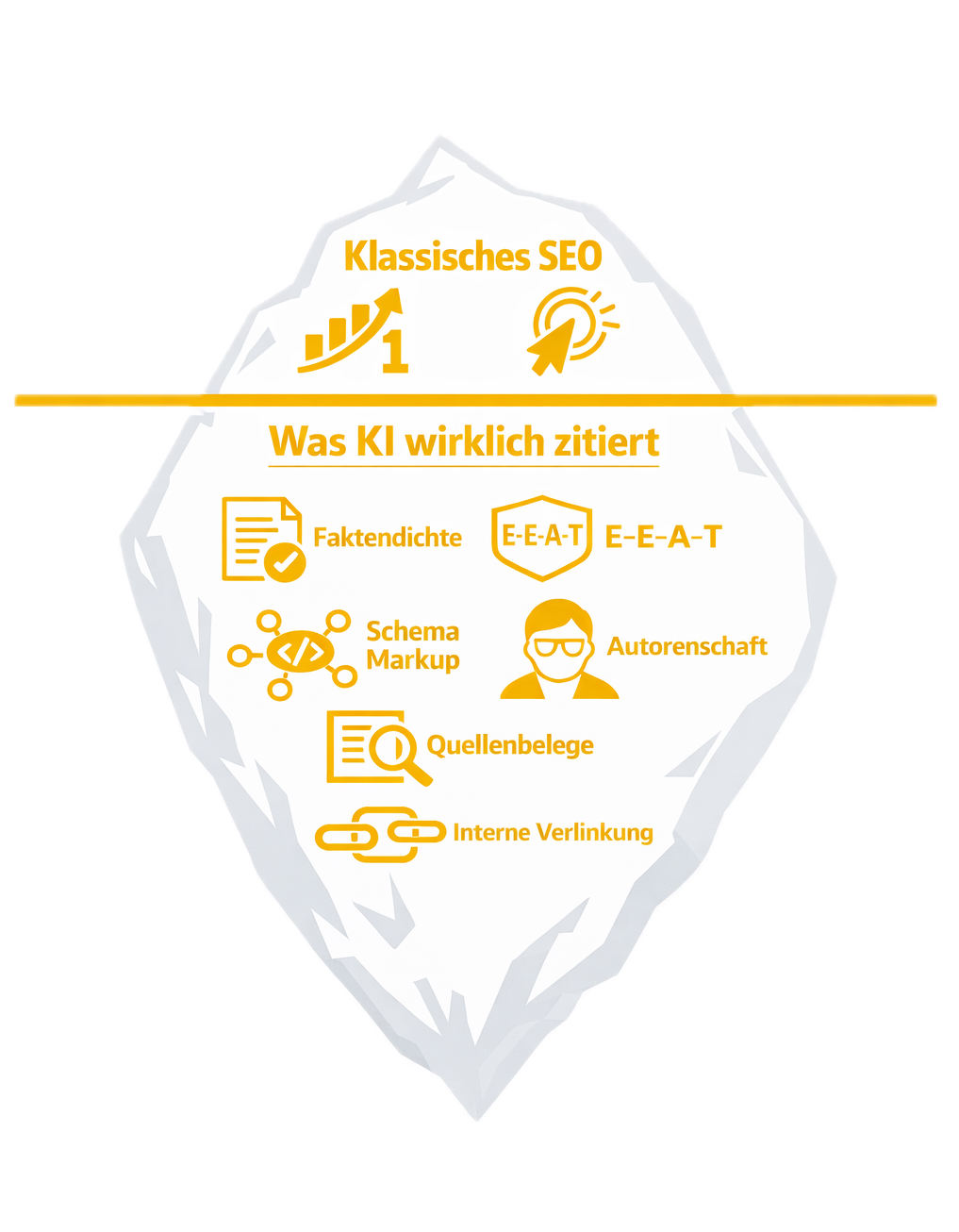
AI systems cite content that meets their requirements for reliability and structure. The framework for this is E-E-A-T - Google's quality criteria for experience, expertise, authoritativeness and trustworthiness. Content that clearly comes from someone with real expertise, provides concrete evidence and is structured has a much better chance of appearing in generated responses.
These features demonstrably increase the citation value:
- Factual statements substantiate with sources - statistics, studies, official data
- Incorporate clear question-and-answer structures - FAQs are preferably extracted by AI systems
- Make authorship visible: Name, qualification, verifiable background experience
- Structured Data and Schema markup so that AI systems can capture content in a machine-readable way
- Short, precise paragraphs instead of long blocks of continuous text
- Consistently create internal links to thematically related content
What this means for your editorial plan
Content production based on the principle of „one article per keyword“ is a thing of the past. AI systems reward thematic completeness, not volume. This means: fewer texts with more depth, a clear structure and reliable sources. Updating existing content regularly and enriching it with new facts signals to AI systems and search engines alike that a page is up-to-date and relevant.
Specifically for planning:
- Check and supplement existing articles for factual density and sources
- Thematic complexes as Content Cluster structure instead of covering individual keywords in isolation
- Schema markup for FAQs, How-tos and implement article metadata
- Create author profiles with proof of expertise and link internally
- Focus backlink building on thematically appropriate domains
- Identify existing top 10 rankings and optimize content for AI citation
FAQs on content relevance and AI
What does content relevance mean in the age of AI?
Content relevance describes how well a piece of content meets the expectations of users and AI systems - no longer through keywords alone, but through thematic depth, factual density and clear structure. AI systems such as Google AI Overviews or Perplexity prefer content that provides precise answers and demonstrates demonstrable expertise.
What is Topical Authority and why is it important?
Topical authority describes the thematic breadth and depth with which a domain covers a topic. Websites with a high topical authority rank faster for new content and are more frequently used as a source by AI systems - because they are recognizable as a technically complete point of contact for a topic.
What is SGE and how does it differ from traditional search?
SGE - now known as Google AI Overviews - generates an AI-summarized answer directly on the search results page and links to selected sources. In contrast to traditional searches, users often do not need to click on the website. Visibility is created through citation worthiness, no longer solely through ranking position.
What is E-E-A-T and how does it influence AI rankings?
E-E-A-T stands for Experience, Expertise, Authoritativeness and Trustworthiness - Google's quality framework for content. AI systems are guided by similar signals: Content with clearly recognizable authorship, documented facts and a structured presentation is cited more often as a reliable source than anonymous, document-free texts.
Do I have to completely reorganize SEO?
Classic SEO remains the foundation - 99 percent of citations in Google AI Overviews come from the organic top 10 results. The existing SEO strategy needs a targeted expansion to include AI optimization: fact density, structure and schema markup. A complete redesign is not necessary.